Oblique intent

Why the name? Well criminal law afficionados will recognise the phrase 'oblique intent' as referring to a problem of mens rea:can a person who intends to do x (such as setting fire to a building to scare the occupants) also be said to have an intention to kill if one of the occupants dies? This is a problem that has consumed an inordinate amount of time in the appeal courts and in the legal journals, and can be taken to represent a certain kind of approach to legal theory. My approach is intended to be more oblique to this mainstream approach, and thus to raise different kinds of questions and issues. Hence the name.

Wednesday, 12 September 2012

On bigamy

The general rule in most common law jurisdictions is that acts committed outwith the territory are not cognisable by the courts of that country. Thus even in a case such as the apparent assassination of a British family holidaying in France last week, it would be highly unusual if the British authorities were to seek to prosecute the wrongdoers (should they be found) in England. Murder is a crime under French law and when committed in France it should be prosecuted there.

As with any rule of this kind there are exceptions (and the list is a growing one) and one of the most curious exceptions is the crime of bigamy. Under the Offences Against the Person Act 1861 s.57, a British citizen who undergoes a bigamous marriage ceremony anywhere in the world (i.e. knowing or suspecting that they are already married) can be prosecuted for the crime of bigamy in England. An example of the application of this rule is the prosecution in 1901 of the second Earl Russell, older brother of the philosopher Bertrand Russell - a case which is also an early example of the, now popular, Nevada wedding.

The trial of Earl Russell before the House of Lords
Russell had first married in 1890, but seems quickly to have become estranged from his first wife - though no divorce or legal separation was secured. In 1900 he obtained a divorce and entered into a second marriage in Reno, Nevada. His first wife then sued in England for divorce on the grounds of bigamous adultery. On returning to the UK he was charged with bigamy, and as a peer was prosecuted before the House of Lords. He sought to argue that on the basis of the "best legal advice obtainable in Nevada" that he had believed the divorce to be legal. However, the House of Lords, acting on the advice of Lord Halsbury, the Lord Chancellor, declined to recognise the legality of the divorce. He was convicted of bigamy and sentenced to three monhs imprisonment. (You can read a contemporary newspaper account of the trial here).

It is worth asking why it was that bigamy should have been treated as one of the few offences under English criminal law of extraterritorial application in the nineteenth century. (Why prosecute for bigamous marraiges committed abroad when you would not prosecute for murder or other serious crimes?) One possible answer to this might be that most murders committed abroad would crimes under the law where they took place, and the authorities there would be expected to prosecute. By contrast, bigamy would normally come to light for the British authorities when the couple were living in England, or as in this case where the first wife sued for divorce in the English courts, thereby making it a problem for the British authorities to deal with. And it is certainly the case that the Victorians were keen to uphold the respectability of marriage.

The Tichborne Claimant
But I think that there is potentially something else involved here as well, which was an anxiety over mobility and identity, which made the crime of bigamy appear to be a particular problem for the Victorians. The nineteenth century was a period in which it become possible to travel as never before. A young man might go abroad to seek his fortune, but this led to new worries as the apparently respectable young suitor might be someone who was seeking to escape a less than respectable past - and this could spell ruin for a respectable woman. And it could be hard to establish just who a person was in an era where there were no fixed or clear markers of identity - leading to such celebrated cases as the 'Tichborne Claimant', where an Australian butcher was seemingly able to pass himself off as the missing heir to the Tichborne fortune. Thus in the crime of bigamy anxieties over identity, mobility and the sttaus of marriage came together, adn the extraterritorial application of the law can be seen as an attempt to control this in a rapidly changing world.

Of course, the extraterritorial application of the crime is of little importance these days, as the prosecution (and presumably incidence) of the crime of bigamy has declined with the more ready availiability of divorce and the decline of marraige more generally. There are still prosecutions, but these now more often concern attempts to breach immigration law, pointing to a change in the focus of the crime which will have to be the subject of a separate post.

Friday, 7 September 2012

On preventing the lawful burial of a body

Criminal offences are like buses. Sometimes they are not used at all, and then several come along at once. And this has been the case this summer with use of the highly unusual charge of 'preventing the lawful and decent burial of a body' in two very high profile cases.

Hans Kristian Rausing
The first is the case of Hans Kristian Rausing, heir to the Tetrapak fortune, who pleaded guilty to the offence and admitted to having kept the body of his dead wife for two months in his Chelsea mansion. Then later in the summer, Jackie Powell, the mental health advocate of the so-called 'Moors murderer' Ian Brady was arrested on suspicion of having committed the same offence. However, the facts in the two cases are quite different, and it is worth looking at these because it suggests that the justification for the offence is confused at best.

In the first case, Rausing admitted to drug use and mental health problems stretching back over a period of some years. On his account, his failure to report the death of his wife (who suffered from similar problems) was due to an unwillingness to face up to the reality that his wife had died. The use of the offence seems to have been a way of ensuring thta he undertook some sort of treatment - he was given a suspended prison sentence and ordered to undertake a drug rehabilitation programme. This may already be troubling, given the existence of civil procedures which might have accomplished the same end, but the use of the the charge against Jackie Powell, is even more worrying.

Police searching Saddleworth Moor 
The facts here are that Brady and his accomplice Myra Hindley were convicted of the murder of five young children in the 1960s. However, they never revealed where the body of one of the victims was buried, and in spiite of regular police searches of the moorland where it is believed to be hidden, it has never been discovered. In this case, then, Brady allegedly revealed the location of the body to Powell, soemthing that was disclosed by Powell during the filing of a TV documentary, though she is claiming privilege and refuses to disclose the location to the police. While this is arguably preventing the lawful burial of the body, what appears to be happening here then is that the threat of the charge is being used to try and force Powell to disclose the location.

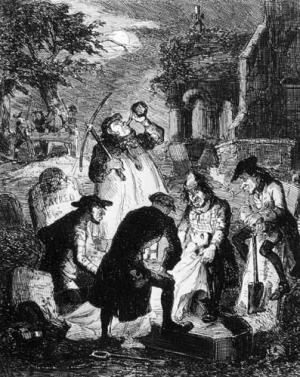
Grave robbers at work
The offence itself is an unusual one and, as is pointed out here, is rarely used. It is a common law offence which was apparently revived in the 1970s after years of desuetude, that seems to have been used where those under a duty to provide a burial, such as gaolers or workhouse masters evaded that duty. Its recent usage appears to be in cases where individuals have sought to conceal the body of someone who has died as a result of some sort of accident or misadventure. It is not immediately obvious why this should be a criminal offence. One justification might be the risk that a decomposing corpse might pose to public health - and this seems to underpin some statutory offences in this area, such as those relating to cremation, or simply the common law offence of leaving a corpse unburied. It seems that something hangs on the concealment - a failure to bring the death to the proper notice of the authorities, but absent concerns over health, this might be dealt with as an administrative offence under s.36 of the Births and Deaths Registration Act 1953. In certain circumstances this could also be charged as obstruction of coroners, where the concealment is to prevent the discovery of a body or to prevent a coroner from carrying out an inquest. This can be justified on the grounds that this would prevent other alleged crimes from coming to light, but this does not appear to be the situation in either of the cases here.

However, as pointed out here, the inclusion in the crime definition of 'lawful and decent' burial, also points to more fundamental beliefs about bodies and their disposal - and, historically at least, the need to give a body a proper Christian burial and to prevent grave robbers passing bodies to hospitals. What is important then is not the fact of burial, but that it should be both lawful and decent, or perhaps more broadly that the corpse should be treated with proper respect. If this is accepted, then it appears that there might be room for an offence of this kind which can be justified on grounds distinct from public health, breach of an adminstrative duty or the concealment of another crime. However, it is not clear either that this should be a serious offence, nor that its use would be appropriate in either of the two cases discussed above.

Friday, 29 June 2012

On holiday

Many thanks to everyone who has visited this blog over the last few months. It has has been fun to write, and pleasing to know that it is of interest to at least a few people out there. I am taking a break now for a couple of months - part vacation but also to complete some other writing projects. I will be back on a regular basis at the end of August, and hope you will rejoin me then.

Thursday, 31 May 2012

On the Murders Abroad Act 1817

Here is the text of this Act passed by the British Parliament in 1817:
“All murders and manslaughters committed or that shall be committed within any other islands, countries or places not within his Majesty’s dominions, nor subject to any European state or power, nor within the territory of the United States of America, by the master or crew of any British ship or vessel … or by any person sailing therein or belonging thereto, or that shall have sailed in or belonged to and have quitted any British ship or vessel to live in any of the said islands countries or places .. may be tried, adjudged and punished … in the same manner as if such offence or offences had been committed on the high seas."
What is striking about this is that it seeks to extend the jurisdiction of the English law of homicide to what the celebrated English criminal lawyer, Glanville Wiliams called “uncivilised territory” i.e. that which is not controlled by Britain, other European powers or the United States. This was passed as a particular response to outrages committed by sailors in the Pacific Islands and certain areas of Latin America. It both demonstrates the hubris of imperial power - our law extends even to those place outwith the dominion of the Crown - and creates an interesting linkage between jurisdiction and civilisation.
 
[There is an archive containing this and simliar legislation relating to the South Pacific at http://www.vanuatu.usp.ac.fj/library/online/texts/Pacific_archive/homepage.htm ]

Monday, 28 May 2012

On the strange case of the Felicidade (1845)


On 26th February 1845 the British ship HMS Wasp was patrolling off the coast of Africa, looking for ships that might be involved in the slave trade. A Brazilian ship called the Felicidade was spotted, and the Wasp gave chase. The ship was captured, but proved to have no slaves on board, though it was fitted out for the slave trade and was clearly on its way to Africa for this purpose. A party of British sailors boarded the ship under the command of a Lieutenant Stupart.

While on board the Felicidade, a second ship named the Echo was spotted, and both the Wasp and the Felicidade gave chase - though the Wasp was quickly left behind. After a pursuit lasting 3 days, the Echo surrendered. The captain of the Echo and its crew of twenty one were taken on board the Felicidade, which was put under the command of a sailor named Midshipman Palmer with nine sailors, while Lieutenant Stupart and a boarding party of seven manned the Echo. That night, however, as Palmer apparently 'permitted himself the luxury of a bath', the captured Brazilian crew rose up, killed the ten British sailors and threw their bodies overboard, before fleeing once more.

The Echo was unable to follow, but three days later the Felicidade was again stopped by another British ship. The crew of this ship knew nothing about the previous events but became suspicious about the unexplained bloodstains on the deck and questioned the the captured men. Eventually two crew members confessed and the Brazilian crew were once more taken into custody. This time they were taken to England where they were tried at Exeter Assizes at the end of July 1845 for the murder of the ten British seamen.


The story so far is fascinating - a forgotten episode in the suppression of the Atlantic slave trade. However, it is the trial and its aftermath which is really extraordinary from a legal point of view. Initially the men were convicted of murder. (Interestingly they were tried in Exeter using of a jury de linguae mediatate - a jury half of whom were non-native English speakers). However, the case was deemed to raise complex legal issues on which further discussion was required, and so these were reserved to the common law judges in London for further argument (there being no proper appeal process at this time). The main point at issue can be briefly stated. It was claimed that the English courts lacked the jurisdiction to try the men for murder: the incident had taken place on a Brazilian ship on the high seas and the identity of victims was insufficient to confer jurisdiction on the English courts.

It was accepted law that English courts had jurisdiction over offences committed on British ships at sea, irrespective of the nationality of the offender. However, it also followed from this that they had no jurisdiction over offences committed on foreign vessels. The case accordingly turned on the question of the nationality of the Felicidade at the time of the incident, for if it were accepted that it was a foreign ship then the crew would have a right to resist using force, for the British sailors would then be acting without lawful authority and could legally be viewed as pirates. For the Crown it was contended that the sailors had acted lawfully under treaties in force between Britain and Brazil for the suppression of the slave trade. Under these treaties it was argued that ships could lawfully be detained either where there were slaves on board or where there was equipment supporting slavery. Accordingly it was argued that the Felicidade in effect became British at the moment of its capture and was operating under British authority. The lawyers for the defence argued that while the original apprehension of the Echo might have been legal under the treaty, there was no jurisdiction in respect of a different crime committed on board a Brazilian ship which they argued had been illegally seized by the Wasp. The majority of the court agreed with this view and the crew of the Echo were set at liberty and returned to Brazil at the expense of the British government.

This is in many ways a surprising decision. It might have been expected that the English Courts would jump to the protection of British sailors who, whatever their precise legal status, were acting in good faith and seeking to suppress the illegal Brazilian slave trade- a project that was actively supported by the government of the time. It might also have been expected that, in the era of Lord Palmerston's 'gunboat diplomacy', the courts would protect British sailors from being murdered. What emerges instead is that the courts upheld (albeit only by a majority) a highly technical reading of the jurisdiction of the courts, which seemed to cut against the political interests of the British state.


The decision, unsurprisingly, was not popular. There are reports of outrage being expressed in Parliament and of the Times thundering its discontent. Commanders of ships on the African coast led boarding parties shoulting 'Remember the Felicidade', and rather than being taken into custody, the captured Brazilian crews were set adrift in boats near the African shore, leading to their almost certain death either at sea or at the hands of Africans if they regained the shore.

Tuesday, 22 May 2012

On legal treatises

In spite of their undoubted importance legal treatises have been somewhat neglected by scholars and historians. The dominant understanding of the importance of the treatise was established in a article published by celebrated legal historian AWB Simpson in 1981. In this he argued that treatises should be understood as a distinct form of legal literature that emerged over the course of the eighteenth century, the distinctive qualities of which were that it sought to identify the principles that should structure the law in a particular area and thereby reveal (or impose) a kind of doctrinal unity on the area of study. For Simpson this was traced in particular through the emergence of areas such as contract or property as distinct principled fields within the common law as a whole.

This view has now been challenged in a collection of essays published this month. While paying tribute to Simpson's groundbreaking work, the essays make two main points. First, the contributors show that the treatise could take many forms, and that not all treatises could fit easily into the template described by Simpson. There is more emphasis in these essays on the kinds of functions that treatises were expected to perform and who they were written by: were they aimed at students or practitioners? Were the authors judges or magistrates, or just hard up barristers trying to make a bit of money on the side? The answers to these kind of questions are often linked to the kind of literature that was produced, and suggests that many authors did not have the systematising ambitions identified by Simpson. Second, by looking at treatises in a wider geogrraphical context than just England - the essays cover the US, Canada and Scotland, as well as England -  it shows that they played a range of different functions often depending on how developed legal institutions were in that particular place.

It would be wrong of me not to declare an interest in this - I wrote one of the essays in the book (on nineteenth century criminal law books) - but even so, this is still a tremendous collection and definitely worth a look.

Wednesday, 16 May 2012

On criminal law's imaginary

A conversation last week got me thinking about this question: what would criminal law's imaginary or ideal world look like?
The ideal city
What do I mean by an imaginary here? I know that the term has a technical meanings in psychoanalytic theory, but want to use it here in a simple sense as a way of just raising the question. This would the question of the criminal law's fantasy image of itself. What does it understand itself to be? In what sort of terms does the law see or understand itself?

Why does this matter? Well one sense in which it might matter is that criminal law theories are often concerned with questions of the normative - how the law ought to be (as opposed to how it is) - and use this as a standard against which to criticise existing law. However, for such criticisms to have purchase they would surely need to engage with how the criminal law sees or understands itself. If, then, the criminal law's self image is based on practicality or efficiency, then the criticism might be understood as misplaced. Another sense in which it might be important would be in terms of understanding its broad self-image or the sense of place or time in which it sees itself operating.

While it common to talk about the imaginary in relation to individuals, it is les common to think about it in relation to a social institution such as law. Can it have an imaginary? And if so where would we find it? And of course it would change over time - there is no single imaginary.

One possibility might be academic writings that order and reflect on the criminal law, or alternatively the judgments of of appellate courts. What do they understand the law to be doing. In what does it consist? What holds it together?


 If this is too complex, another possibility is that we could look at the works of individual authors who hvae developed a theory of the criminal law, and ask the question of that theory. One example that comes to mind here is this quote from Jeremy Bentham, which comes at the end of "Of laws in general", in which he has been developing his theory of the criminal code:
On a map of the law executed upon such a plan there are no terrae incognitae, no blank spaces: nothing is at least omitted, nothing unprovided for: the vast and hitherto shapeless expanse of jurisprudence is collected and condensed into a compact sphere which the eye at a moment's warning can traverse in all imaginable directions
What is striking to me about this quotation is that it lays bare in a single sentence the whole machinery of the law as conceives of it: everything is known in law; everything is mapped and ordered; But more than anything else it captures a dynamic of speed and efficiency. The eye of the lawyer moves through the code as the panoptic eye moves through the social body, alert and responsive. It is bleak and somewhat intimidating picture, and revealing of the imaginary of this project of codification.

For some reason this phrase always makes me think of Piero della Francesca's famous image, the ideal city. It is a beautiful painting of symmetrical renaissance palazzi. It demonstrates the techniques of perspective. But in reverse from the normal technique of opening out from a central object in the foreground to a broader landscape in the background, this painting pulls us in to the circular palace in the middle.

The Ideal City?
And look more closely. The city is organised on a grid: the lines of the square go out in every direction; the buildings are in squares, replicating the city plan; and the only curve is in the central circular building, perhaps anticipating the panoptic eye of Bentham's code. (Even the sky follows the same linear pattern). Above all this is the ideal city without people - whose presence is only hinted at by a couple of plants in windows. It is the city imagined as pure order, like Bentham's code, and its beauty is ultimately terrifying.