Oblique intent

Why the name? Well criminal law afficionados will recognise the phrase 'oblique intent' as referring to a problem of mens rea:can a person who intends to do x (such as setting fire to a building to scare the occupants) also be said to have an intention to kill if one of the occupants dies? This is a problem that has consumed an inordinate amount of time in the appeal courts and in the legal journals, and can be taken to represent a certain kind of approach to legal theory. My approach is intended to be more oblique to this mainstream approach, and thus to raise different kinds of questions and issues. Hence the name.

Friday, 21 December 2012

On homicide in America

It is just one week since the horrific shooting of school children and teachers at Sandy Hook elementary school in Connecticut. In that time a lot has been written about the possible causes of the massacre the need for gun control, and what should be done to prevent similar events occurring in the future. It is with a certain degree of reluctance that I enter this debate, for both the killing itself and the topic of gun control are highly emotive subjects, but there is nonetheless something to be learned from taking a broader perspective on these events.

Map of the world by intentional homicide rates (from Wikipedia)
A starting point for discussing this is that the rate of homicide in the US is high -  much higher than in any other affluent first-world democracy - and thus that incidents such as the Sandy Hook shooting have to be seen in this context. There has been a slight decline in the homicide rate over the first part of this century, but the overall pattern suggests that homicide rates have been higher in the US than in other western countries since the middle of the nineteenth century.

One explanation of this is often seen in the availability of firearms. A useful starting point is this map which shows rates of gun ownership and homicide by firearm worldwide. This makes it clear in a graphic way that there is some link between the availability of firearms and firearm homicides . This is hardly surprising. The availability or accessibility of certain weapons is going to be linked to violence caused by those weapons. If gun ownership is severely restricted then one would expect to see fewer homicides by firearms simply as a matter of opportunity. Thus, the map shows that while the US has one of the highest rates of gun ownership, it does not have the highest overall rate of firearm homicides. And this is something critics of proposed measures for gun control have been keen to point out: there are societies with high levels of gun ownership but a reasonably low murder rate; or conversely there might be a high murder rate in certain countries but low gun ownership - and so that murders are committed in other ways. However, it is also worth noting from the map that the percentage of all homicides committed by firearm is high in the US.Overall then gun ownership might make it easier to commit certain kinds of homicides, but do not necessarily offer a causal explanation of high rates of homicide. This might be an argument for certain kinds of gun control, as a way of reducing opportunity, but these kind of measures would not necessarily lead to a decline in the overall rate of homicide in the US.

An alternative and illuminating perspective can be found in Randolph Roth's brilliant book, American Homicide. This is a wide ranging historical survey of homicide in the US from the colonial period - when America had one of the lowest homicide rates - to the present day. Roth is sceptical of claims that the rising homicide rate can straightforwardly be linked to such factors as the relaxing of carrying concealed weapons laws or the availability of drugs or alcohol, pointing out that there are countries which consume drugs or alcohol at higher rates than the US yet have lower homicide rates. Instead he identifies four factors that are associated with low homicide rates:
  • A belief in stable government and that legal and judicial institutions are unbiased;
  • A feeling of trust in government and the officials who run it;
  • Patriotism, empathy and fellow feeling arising from racial, religious or political solidarity;
  • The belief that the social hierarchy is legitimate, that one can be reasonably content with one's place in society or the opportunities to change it, and that one can command the respect of others without resorting to violence.
These are perhaps unsurprising - people are less less likely to resort to homicidal violence when they trust in legal and political institutions, when they feel that they have a valued place in society and when all groups have equal respect and access to social goods. And interestingly they point to the importance of law - but not as a mechanism that can reduce violence through the deterrent effect of harsh punishment. Law is instead important as a background institution that can secure social expectation and opportunity and generate trust and respect between citizens.

[You can check out the data at the historical violence database]

Saturday, 15 December 2012

On 'word crimes'

A curious characteristic of nineteenth century criminal law was the criminalization of language - so-called word crimes - as seen in the unholy trinity of sedition, blasphemy and obscenity. This might seem counter-intuitive: this was, after all, a period of political liberalization and increased respect for individual liberty. But paradoxically it is precisely this liberalization that lies behind the expansion of the criminal law. On the one hand, increasing political freedom and the relaxation of restrictions around the printing and publishing of books and periodicals led to anxiety about the social impact of 'subversive' speech and writing: what were the servants reading and what effect would it have on them? And on the other, the focus on individual responsibility in the criminal law made it possible to expand criminal regulation to these areas by making the intention of the author central to the question of criminal liability.

While the precise development of each of the three crimes is slightly different, there is a clear pattern. They are all old offences, which were of little practical importance until the late eighteenth and early nineteenth centuries. They were each given new life in response to social and political developments. They were used sporadically throughout the nineteenth century, particularly at moments of political and social unrest and (with the exception of obscenity) fell into a gradual decline. There are also clear structural similarities in the way that the crimes were defined in the modern law.

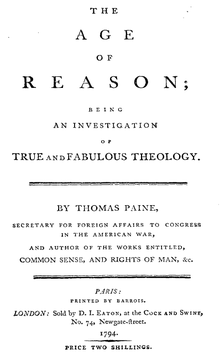
Tom Paine's The Age of Reason:
Seditious in 1792
The origins of the crime of sedition can be traced back to Roman law, where it was understood as a form of violent insurrection that was related to treason. But by the late eighteenth-century it had become the crime of the crime of speaking or publishing words which criticized the sovereign or brought the existing government or laws into contempt. In England the law of seditious libel was used in the wake of the French Revolution to prosecute radicals, such as Thomas Paine who had written books or given speeches arguing for political reform. In Scotland the use of the law was even more draconian, with members of the Society for the Friends of the People convicted for sedition and transported for 14 years. This use of the law was fraught with difficulties as those prosecuted would frequently argue that what they had said or written was not seditious in intent - and juries would occasionally even acquit. So as the immediate political tensions of the 1790s and the Napoleonic Wars passed, the law came to be used in a more limited way. Sedition was still used to prosecute political dissent, but instead of a general focus on the seditious content of the language, definition of the crime came to focus on the potential impact of the language to cause immediate public unrest and the the intention of the speaker or author - whether they knew or ought to have recognized that disturbance was a likely cause of their conduct. The modern crime was thus less about language that might undermine society, but language that might incite unrest. The crime was rarely used in the twentieth century and was abolished in 2009.

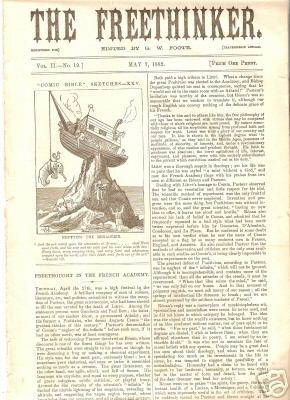
The Freethinker
Blasphemous in 1883
Blasphemy was likewise an old crime. Its modern origins lie in the separation from the crime of heresy in 1656. While heresy was a crime against God, it was only a crime under ecclesiastical law. Blasphemy, by contrast, was understood as a crime against human law because attacking the christian religion was seen as an attack on those bonds which held civil society together. In this form there had been occasional prosecutions of blasphemous writing in the seventeenth and eighteenth centuries, but the crime was regarded as a minor one, and of little practical importance until the prosecution of the bookseller William Horne in 1817. Although these prosecutions were unsuccessful, this established a patter for the use of the crime in the nineteenth century to prosecute writings of religious dissenters and freethinkers. The core of of the crime was less in the content of the beliefs expressed, than the tendency of the the words - the manner and context in which they were expressed - to undermine society. The last successful prosecution for blasphemy was in 1922 and the crime was abolished in 2008.

Obscene libel was also a crime at common law, but the modern law has its origins in the Obscene Publications Act 1857. This retained the common law definition of obscenity, but for the first time separated sexuality out as an area of special concern and gave the police new powers to seize and destroy obscene material. The test of obscenity laid down in Hicklin (1868) had two central characteristics. First, that the material should have a tendency to deprave and corrupt. This was directed at the effects on the individual, not necessarily as matter of literally depraving or causing immediate arousal, but of how the text or image as a whole could be interpreted and its longer term perverting effects. It was thus concerned with imagination and interpretation. Second, it was specifically directed at the need to protect those who might be vulnerable to such influences —whether women, children, or (in the notorious formulation) domestic servants. In this version the law has survived to the present day, with the test for obscenity even being reproduced in recent legislation criminalizing extreme pornography.

What do they have in common? The first thing is that the modern offences are directed less at the content of the beliefs than the tendency of the expression of the beliefs to undermine society. In each case it is recognized that it might be legitimate to express those beliefs - political or theological debate, or artistic expression - but that in certain circumstances, with a certain intent, that these forms of expression might be dangerous. It is the tendency of the beliefs to undermine society that is crucial, rather than their actual impact. In sedition and blasphemy the crime is concerned with the impact on society; in obscenity law it is concerned with thecorrupting impact on the individual. But in each case the structure of the offence is the same. And all are concerned with the imagination: the imagination of the vulnerable reader or listener, who may not be able to resist, as well the ability of the authorities to imagine the worst.

Friday, 7 December 2012

On violence and modernity

One of the aims of the civilizing process is that of reducing, even eradicating violence. According to writers such as Elias, an effect the process of state formation in western societies and the gradual change of manner and sensibilities, was that of changing our idea of civilized conduct, making modern man more humanitarian. And this insight seems to be borne out in various ways in historical studies of crime. Levels of interpersonal violence and homicide rates are in decline. There may be disagreement over the precise reasons for this development, but little disagreement over the fact that it is taking place.


What does this mean for criminal law? Again, certain parts of the story seem clear. The criminal law was used by the state as an instrument for reducing social violence. In many cases the norms already existed, and what changed was the enforcement of the law - which gradually changed the social understanding and expectation of what was permissible. Thus, forms of public violence, such as brawling, that might have been regarded as acceptable were policed more rigorously. Duelling was outlawed. Laws were passed prohibiting the carrying of weapons in public places Forms of private or domestic violence, in particular gendered violence, and violence against children such as smacking, which had been regarded as acceptable in law have been regulated by new norms or changed forms of policing. And this is matched by governmental rhetoric which declares that every person should be entitled to live their life free of violence, and so on. The governing assumption seems to be that the body is inviolable.

The problem, of course, is that this promise is unlikely ever to be delivered upon, and this may create a damaging cycle. From the perspective of the individual it creates the expectation that we can live our lives without violence or the trauma it causes - indeed the violence may be more traumatic precisely because the expectation that our lives should be violence free is so strong. So when this expectation is defeated, it translates into a demand for recompense or that something be done by the state. From the perspective of the law, the inviolability of the body persists as a norm-giving assumption notwithstanding that it is continually violated. Indeed, its failures to meet these high expectations of interpersonal security may mean that it generates new laws - the demand from victims, or putative victims, is used to demand new, ever more draconian or intrusive, laws to secure us against future harm. And so we criminalize in ever more ingenious and intrusive ways. But it is perhaps necessary to step back and reflecting the logic of this process of criminalization.

Monday, 3 December 2012

On the illegality of sodomy in the US


I have just discovered this map:
[From: http://www.motherjones.com/mojo/2011/04/map-has-your-state-banned-sodomy]

It is hard to know what to say. I have to confess that I am shocked that laws against sodomy remain on the books in so many states in the US in spite of the Supreme Court ruling in Lawrence v Texas (2003) that these were unconstitutional. Of course, it can be argued that these laws have no force, but the very fact that they have not formally been repealed has symbolic force and sends a clear message about the public tolerance of homosexual activities. Even criminalization without the possibility of enforcement is not entirely innocent.


Thursday, 15 November 2012

On the Verdict of Battle

I have just attended a fascinating seminar by James Whitman of Yale University based on his new book 'The Verdict of War'. The main argument of the book, briefly stated, is that up until the mid-nineteenth century war was understood as a means of settling property disputes, and battles were a form of wager, with the winner taking the spoils. The law of war, such as it was, was accordingly mainly concerned with determining the question of who had won, and trying to encourage broadly civilized conduct on the part of the combatants. And insofar as these were the ends, Whitman claims, it was broadly successful. A feature of pre-modern warfare was that battles were limited in time (no more than one day), and violence was confined to the battlefield and to uniformed participants - to the extent even that spectators would come from neighboring towns to watch. Of course, if you were a soldier it could be brutal, and it was accepted that the winners could loot the corpses on the field of battle and kill any survivors. This is then contrasted with modern warfare, where battles can go on for indeterminate periods, fatalities among non-combatants are routine, and there is no means for determining who has won other than trying to crush the enemy and secure unconditional surrender. This, controversially, is explained in terms of the collapse of monarchy and the rise of democracies and republics, where war is conducted in the name of the people - and the 'people' therefore become legitimate targets and will fight until they can fight no more.

There is a lot in this argument, and it is hard to do it justice in a short summary, but what particularly interests me is how the criminal law becomes part of this story.

According to Whitman, from the late nineteenth-century, humanitarian campaigners began to try and limit the horrors of war through the introduction of prohibitions on certain kinds of conduct - ensuring that survivors could not be killed or looted, introducing rules about the recognition of combatants and non-combatants and the limits of proper behavior in war. These kind of prohibitions now make up a substantial part of the modern law of war, as well as being linked to forms of international crime, such as crimes against humanity. While these are surely a great advance, Whitman questions the limits of the criminal law in this area. There are two aspects to this (and here the argument is my reconstruction of what I thought Whitman said, so may not be entirely accurate). First, it is not clear how useful or effective criminal law can be in a war situation, where you are dealing with scared or brutalized individuals. To be sure, these laws might provide for some limited redress afterwards, but we should be wary of claims that the law can guide conduct in war situations. Second, Whitman points out that this individualizes the law of war: it is no longer concerned with regulating conflicts between states, but with trying to determine just outcomes for individuals. The consequence of this is that the criminal law gets wrapped up in attempt to sanitize or humanize war. There are many reasons might we might want to do this - though better yet to avoid it altogether - but it is worth reflecting on whether the criminal law is an appropriate tool for for achieving these ends, or worse still, whether through this exercise we end up legitimating further violence.


Thursday, 8 November 2012

On 'the Gallows'

I have posted before about the fascinating project 'Punishing Photography', and I would strongly recommend that you visit the site and see how the work is developing. Yesterday was the opening at Barlinnie Prison of an installation from the project. This is not open to the public, but you can see a short video of this impressive and haunting piece of work here, and see some of the photographs and read descriptions of how the work has developed on the blog.

The installation will be open to the public at the Briggait in the spring of next year - watch this space for details.

Thursday, 1 November 2012

On joint enterprise


Those of us who work in the area of criminal law should never forget that the rules of criminal law have a profound impact on the lives of members of our society. This is brought home powerfully by this short film from campaigning group JENGbA (Joint Enterprise Not Guilty by Association).

The film (and the work of the group) highlights the large number of cases where individuals who appear to have been on the fringes of groups that have carried out killings have been charged with and convicted of murder, leading to heavy prison sentences. This is made possible because of the doctrine of joint enterprise.

This is a legal rule that basically holds that all those who are involved in a common enterprise can be held liable for the outcome of that enterprise provided that it is possible to demonstrate some sort of common purpose. Thus it is not necessary for the Crown to prove that the individual charged had the mens rea for the ultimate crime (say murder) provided that it can be proved that intended to share in the purpose or joint enterprise of the group. The existence of the rule is explained on the ground that where a group commits a crime it should not be possible for a member of that group to avoid liability. The rule is thus explicitly aimed at  groups or gangs where proof of membership or involvement may be enough to establish liability for crimes committed by the group.

But this is also where problems arise, because as JENGbA contend, there is evidence that the supposed social threat posed by gangs is being used to prosecute and convict individuals of serious crimes where, if they are guilty of anything at all, it is a much lesser involvement in the crime.

The question is what is to be done. This is an issue that has been looked at by the House of Commons Justice Committee, which has produced a report on the law and recommended both that the DPP produce guidelines for prosecutions in this area - and these have been promised - and that the law be placed on a sttautory footing. But while this has the potential to deal with future cases, by placing some sort of constraints on how the doctrine is used, it is not clear that this can deal with underlying problems with the doctrine itself.
Just as importantly, though, what will happen to those convicted under the use of this harsh and iniquitous doctrine?