Oblique intent

Why the name? Well criminal law afficionados will recognise the phrase 'oblique intent' as referring to a problem of mens rea:can a person who intends to do x (such as setting fire to a building to scare the occupants) also be said to have an intention to kill if one of the occupants dies? This is a problem that has consumed an inordinate amount of time in the appeal courts and in the legal journals, and can be taken to represent a certain kind of approach to legal theory. My approach is intended to be more oblique to this mainstream approach, and thus to raise different kinds of questions and issues. Hence the name.

Tuesday, 3 September 2013

On criminal codes

When we think of criminal codes it is normal, at least for me, to think of the great codifications of criminal law that took places from the late eighteenth and nineteenth centuries. But of course there is another sense of 'criminal code' - that of a code for criminals - and this is perhaps why the former sort are often referred to as penal codes (though this is confusing as they do not only detail punishments, but also codify forms of permissible and impermissible conduct). The relationship between crime and punishment in the modern criminal law is a complex one, and is a topic that I  shall return to in future posts, but for now I want to say something about criminal codes as codes for criminals.

The thought is prompted by the death of the famous crime writer, Elmore Leonard, last month. As a notable
stylist, he is well known for his 10 rules of good writing (the writer's code). Slightly less well known are his rules for successful armed robbery (from the novel Swag). These are:
1. Always be polite on the job, say please and thank you. 
2. Never say more than is necessary. 
3. Never call your partner by name – unless you use a made-up name. 
4. Dress well. Never look suspicious or like a bum. 
5. Never use your own car. 
6. Never count the take in the car . 
7. Never flash money in a bar or with women   
8. Never go back to an old bar or hangout once you have moved up. 
9. Never tell anyone your business. Never tell a junkie even your name. 
10. Never associate with people known to be in crime.
All of this seems eminently sensible - and of course in the novel things start to go wrong for the protagonists when they start to ignore their own rules.

While I don't want to encourage crime, it does make me wonder what other rules for the successful commission of crime we might come up, based on what seem to be common errors. Here is a start on my alternative criminal code (based on cases I have read about):
  • If you are fraudulently claiming disability benefit, it is probably better not to participate in a 10K race; and if you must, try to avoid having your picture taken at the finishing line.
  • If you are planning to poison someone do not tell the chemist that the poison you are buying is to kill rats, especially if there is not trace of a rodent problem at your home.
  • Most people offering their services as contract killers on the internet are probably undercover police officers (from the recent Canadian case of Ryan)
  • If the you and your associate in crime are arrested, it is best to avoid discussing your exploits within earshot of the police.
If you know of other rules, please add them below.

Monday, 1 July 2013

On holiday

Thanks to everyone for your support over the last 12 months. I am now on holiday and will resume posting on the blog in September 2013

Tuesday, 25 June 2013

On imprisoning bankers

The Report of the UK Parliamentary Commission on Banking Standards made a bit of a splash last week, with a lot of the media attention focusing on the proposal to create a new criminal offence of reckless misconduct in the management of a bank (see volume II chapter 10), which might ultimately lead to bankers being sent to prison. It is seen as important, in the words of the report, that there be "robust tools for holding those responsible to account and imposing appropriate penalties".


It is undoubtedly the case that there is a certain populist appeal  to this kind of proposal. After all, as banks like RBS and HBOS were exposed as having run huge financial risks and being on the verge of collapse, there was a lot of public anger directed at those individuals who were perceived to have mismanaged the institutions. Fred Goodwin's Edinburgh home was attacked and he was ultimately stripped of his knighthood. A new criminal offence would play well with the public discontent with the conduct of the big banks. And there is a kind of schadenfreude involved as well. For years, critical criminologists have complained that certain kinds of minor property or street crime are sanctioned more heavily than the more serious financial wrongs committed by those such as bankers or financial institutions - yet they continue, not only to get away with their financial 'crimes', but also to be handsomely rewarded, while petty thieves are relentlessly prosecuted. As the celebrated title of one book has it: the rich get richer and the poor get prison.


The arguments given in favour of individual criminal responsibility are as follows:
  • That the existing sanctions regime (ineffective as it is) is directed at institutions rather than individuals, but that certain individuals play an important role in determining the policy and culture of the institution.
  • That the potential harms created are public harms rather than private harms (i.e. internal only to the banks) because of the damage to market confidence and the use of public funds to bail out the banks
  • That criminal sanctions could act as a deterrent to individuals, and that this could alter the conduct of the institution as various responsible individuals made more effort to supervise the conduct of those under their direction.

However, as the report itself notes, enforcement agencies already experience huge difficulties in establishing any kind of fault. In the words of one witness, Tracy McDermott, talking about previous investigations:
    We invested a significant amount of time and resource into the investigations we did into the failed banks, but we were not able to establish the evidence necessary to take regulatory action, so even if there had been a criminal offence on the statute book, that would not have got us there ... If the evidence is not there, it will not be there for criminal cases in the same way as it won't be there for regulatory cases. You can debate whether we got that call right or wrong, but ultimately the evidential standard is higher in criminal cases
There are a number of reasons given for this: the standard of proof in criminal cases is higher than in civil cases; a successful criminal investigation requires huge resources to filter the enormous number of documents, which regulators or prosecutors do not possess; and, crucially, responsibility is diffused in large organisations, with few (if any) individuals have direct oversight or knowledge of all decisions that are taken.


Any new criminal offence is, thus, likely to face a number of potential difficulties. What about the offence proposed by the Commission?

The proposed offence would  be that of reckless misconduct in the management of a bank. There are a number of features to note about this. The first is that this requires 'misconduct'. Thus while the need for an offence is framed in terms of the harm caused, on the face of it this does not require any actual harm, only misconduct (and presumably potential harm). This might make it easier to prove as it would not be necessary to show that the conduct led to the specified harm.  However, what is required is presumably some conduct that is a clear departure from 'normal' management practices, and a lot would rest on how these were defined or understood.

The second point to note is that the crime is 'reckless' misconduct. This would mean, according to the Commission, that the normal criminal law standard of subjective recklessness should apply. While this may be preferable to a strict liability offence or an offence of negligence, it would be hard to prove. Proof of recklessness in English law requires proof that the person charged was aware of the risk and that it was unreasonable in the circumstances for them to take that risk. This may give rise to two significant problems. First, in a large and complex organisation, it is notoriously difficult to establish who was aware of what, as decisions are delegated or taken by committees. The Commission attempt to get around this by stressing that the important factor is whether or not a manager or director should have been aware of the conduct of those under their charge - the so-called accountability structure - but this may conflict with the criminal law standard of subjective awareness. The second difficulty will be that of establishing what is unreasonable in the circumstances. Is this unreasonable by the standards of the average banker? If this is the case, if the culture of the banks is 'out of control' it may be hard to establish unreasonableness because the defence will be that other banks were doing the same thing - and that the conduct was therefore reasonable. It may be that this would catch only clear or egregious cases of misconduct - which might very well already be criminal under the laws of fraud, market abuse or insider dealing anyway.


So where does this leave us? The Report is recommending the creation of an offence that is to be used only in rare cases where the most serious harm has resulted as a result of (presumably serious misconduct). It will have a high standard of fault, and therefore be difficult to prove, to cover situations where it is already conceded that it is difficult to meet even the lower civil standard of proof in enforcing regulations. It is, then, to imagine that we will see any bankers being jailed any time soon.

Of course, it might then be replied that the point is to show that the criminal law reaches these areas - that no one, not even bankers, is above or beyond the law. This might be important as a kind of symbolic politics, but it is surely pointless to create new criminal offences that clearly overlap with existing offences and which have little prospect of successful enforcement. There is undoubtedly a case for a creating a meaningful sanction regime in this sector, which would include criminal penalties, but this proposal does not make that case.


Tuesday, 11 June 2013

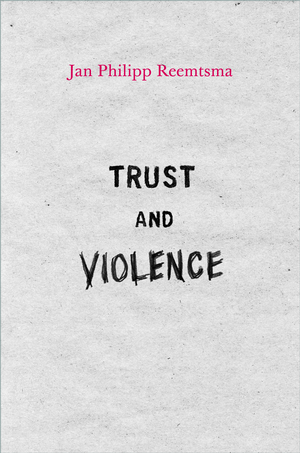
On Trust and Violence

I have spent a lot of time of the past few months reading and thinking about a fascinating book called Trust and Violence by Jan Philipp Reemtsma. It is not directly about criminal law, or even about law at all (except indirectly), but it raises a lot of important questions about the role (and limits) of institutions such as the criminal law in modern society.

Reemtsma identifies three central questions. First, how does modern Western society legitimate the use of violence, and what was distinctive about the way that it did so? Second, how does this culture reconcile its self image of decreasing violence with the actual violence that it produces? And third, why is it that the violence excesses of the twentieth century - the holocaust, the Stalinist purges, wars - have not prompted us to abandon the project of modernity altogether? It became commonplace to ask how we could go on after atrocities on this scale. Reemtsma's response is to raise the flip side of this question: given that we did go on, and continue to go on in spite of these outbursts of extreme violence, what were the kind of social mechanisms and institutions that made this possible?

His answers to these questions are wide ranging. He discusses literature, history, social theory and more. And the text is challenging, but worth the effort. I can't really do justice to the complexity and richness of the argument, so I shan't try here, though I will try to discuss it in relation to specific topics in later posts. 

For now, let me leave you with this video of a talk he gave at University College Dublin. 


Tuesday, 14 May 2013

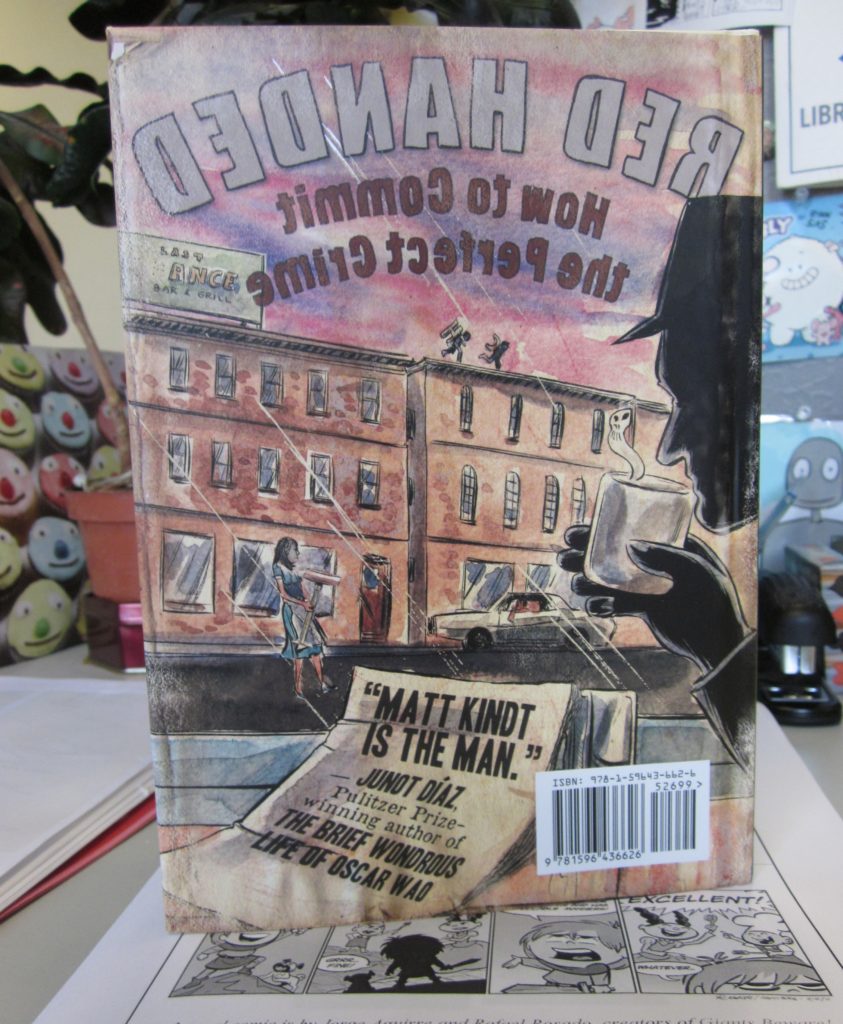
On The Fine Art of Strange Crimes


Welcome to the city of Red Wheelbarrow, where the world's greatest detective has yet to meet the crime he can't solve—every criminal in Red Wheelbarrow is caught and convicted thanks to Detective Gould's brilliant mind and cutting-edge spy technology.


But lately there has been a rash of crimes so eccentric and random that even Detective Gould is stumped. Will he discover the connection between the compulsive chair thief, the novelist who uses purloined street signs to write her magnum opus, and the photographer who secretly documents peoples' most anguished personal moments? Or will Detective Gould finally meet his match?


This is a wonderful, and wonderfully engaging take on the tradition of the hard boiled detective. In this world it is the art of theft, as much as the theft of art, that is important. And this poses a different kind of challenge to the indefatigable Detective Gould. But my favorite part is the interrogations, as suspect and detective engage in metaphysical and political discussions of the nature of crime.


Well worth a look.

Thursday, 9 May 2013

On the meaning of consent in the Sexual Offences Act 2009

There has been a slightly worrying development in Scotland with respect to the interpretation of the new Sexual Offences Act 2009. The Court of Appeal has overturned the conviction for rape of a man who had sex with a woman who was apparently unconscious at the time the intercourse started, and who claims that she withdrew consent immediately she regained consciousness, while the intercourse was still going on.

This is how it has been reported in Scottish Legal News:
The 24-year-old student told the jury that she could not remember how the sex started on account of being intoxicated but subsequently withdrew her consent upon realising what was happening.

Lord Eassie, Lord Brailsford and Lord Philip at the High Court of Justiciary in Edinburgh ruled that Mr Mutebi had a “reasonable belief“ that the woman was a willing partner and on the facts there was not enough evidence to counter that claim.

No force had been used on the woman and it was held her distress the following morning was not sufficient to support a claim that Mr Mutebi knew she did not consent.
While the full judgement has not yet been published, and it may be that when it is the Court will come up with some convincing reasons for this decision, but on the face of it it is puzzling, and seems to run counter to the stated intentions of the Act.

There are two reasons for this. First, under the Act, it is explicitly stated in s.13(2)a) that there can be no free agreement where "where the conduct occurs at a time when B is incapable because of the effect of alcohol or any other substance of consenting to it." So, where a complainer was so drunk that she could not remember how the sex started (and assuming that this evidence is accepted), this by definition must be regarded as rape.

Second, under s.15 it is explicitly provided that consent may be withdrawn at any time, and that if the conduct then continues then it takes place without consent. So, even if the court did not accept the complainer's story about being so intoxicated that she did not know when the intercourse started, if she was a credible witness on the issue of withdrawal of consent, then the intercourse should have been regarded as non-consensual - and the accused could not then be regarded as having a reasonable belief in her consent.

This all seems fairly clear, and was discussed at great length in response to the Law Commission Report recommending reform of the law, the passage of the Act through Parliament and in training delivered to the judiciary preceding the implementation of the Act. So how has it come to this?

My suspicion is that confusion has arisen from two sources - one related to the drafting of the Act, and one more general. 

Under the Act rape is defined in s.1 as:
If a person (A), with A's penis a) without another person (B) consenting and b) without any reasonable belief that B consents penetrates to any extent, either intending to do so or reckless as to whether there is penetration, the vagina, anus or mouth of B, then A commits an offence, to be known as the offence of rape.
Now this is hardly the most lucid piece of drafting around (note that the recklessness appears to refer to the conduct of penetration rather than the state of mind of A), but it seems to require two steps: that the conduct should be without the consent of B, and that A should not have any reasonable belief that B consents. Now the vagueness is this: do the definitions of situations where there can be no consent (in s.13) apply to both steps, or only to the former. In other words, do the situations set out in the Act refer to situations where  a) there is no consent/free agreement, and b) that there can accordingly be no reasonable belief in consent, or do they only refer to the first step, meaning that the Crown would still have to prove the absence of reasonable belief? In my view, it must be the first of these, for otherwise the whole purpose of the law must be undermined. But it appears that the Appeal Court has taken the alternative view.

If this is the case then it gives rise to another problem, which seems to be referred to in the press report, namely that if it is necessary to show the absence of reasonable belief (the state of mind of A), then the Crown must corroborate this somehow. And here the Court has fallen back on the pre-2009 law which has held that the beliefs or mental state of the accused cannot be corroborated by evidence of the distress of the complainer.

So this decision seems to return us to where we were before the Act was passed, as s.13 has been interpreted narrowly, and all the old problems of corroboration then return. And that is surely grounds for concern.

Tuesday, 30 April 2013

On when the law is an ass


I have copied in the text of a story reported on the BBC Scotland News website yesterday.
A homeless man who was found sitting outside a bank with a bright orange toy gun has been convicted of having an "imitation weapon". Scott Park, 33, was handcuffed and led away by police after being found with the toy gun outside the Royal Bank of Scotland in Stirling in June last year.
Initially he was charged with a breach of the peace but prosecutors changed it to one of breaching the Firearms Act.
During the sheriff-only trial at Stirling Sheriff Court, CCTV footage was shown of Park huddled on the steps of the bank, which was closed at the time, as passers-by occasionally dropped coins in his plastic cup.
Police were alerted after a teenage girl saw the bright orange gun fall out of his pocket. She said she asked him what he was going to do with it and that he had replied he was going to use it if people refused to give him money. She said she was not sure if he was joking.
Depute fiscal Lindsey Brooks, prosecuting, argued a toy gun could fall foul of the Firearms Act if it "looked like a gun". Alistair Burleigh, defending, said the item his client had was "fluorescent bright orange, entirely constructed of plastic, and quite obviously simply a toy". A firearms expert told the court the gun was perfectly legal and it was bright orange because legislation says that non-imitation toy guns have to be a bright colour to distinguish them from real guns.
But Sheriff O'Carroll said it had the appearance of a firearm. He said children had "lawful excuse" for possessing such things - for playing cowboys and Indians. He said the case raised "a major public policy issue".

While there may have been other things going on that we are not aware of from this short report, on the face of it this looks ridiculous. It hardly bears comment, but I will make one or two points.

First, it appears that he was charged under the Firearms Act 1968 s.19, the text of which is as follows:

A person commits an offence if, without lawful authority or reasonable excuse (the proof whereof lies on him) he has with him in a public place
(a) a loaded shot gun,
(b) an air weapon (whether loaded or not),
(c) any other firearm (whether loaded or not) together with ammunition suitable for use in that firearm, or
(d) an imitation firearm

The obvious point concerns the definition of an imitation firearm. It seems fairly clear that everything that looks like a gun or is gun shaped should not be treated in law as an imitation firearm. This, indeed, is the point made by the defence expert when arguing that toy guns were made in such colours precisely so they could not be mistaken for real firearms. This not only creates an inconsistency in the law (what is legal for one purpose is illegal for another), but raises the possibility that that the law is dramatically extended here as any possessor of a toy gun in a public place (except children - though we will come to that in a moment) is committing an offence.

Second, what is a reasonable excuse? It is obviously not enough of an excuse that something is a toy, is flourescent orange, and that no reasonable person over the age of 5 would mistake it for the real thing. It is an excuse, it appears, to be a child playing "cowboys and Indians". This is extraordinary. Presumably a child under the age of 12 could not be charged with an offence anyway (unless the Sheriff has forgotten the recent change in the law); and in my experience children over age of 12 have usually grown out of playing with toy guns. But it is also an extraordinary failure of judicial training. Is this Indians from South Asia, or Native Americans? His language is out of date and out of touch.
Third, while it is easy to criticisze the Sheriff here, we should not forget that it takes more than a judge to produce this outcome. Both police and prosecution must bear some responsibility for this coming to court. It is often argued by the police in such cases that the charge is merely a pretext to offer help or assistance to a person, or to take them out of a situation where they are causing distress to the public. That may have been the case here - and we do not know - but it is hardly an excuse for abusing the law in this way.

Finally, the Sheriff apparently states that there is a major public policy issue. For once I agree with him. There is a major issue here, but it is not the one he is referring to. The real issues here is the over-criminalization of the homeless, and the misuse of the criminal law. And responsibility for that lies with the police, the prosecution and the courts.