Oblique intent

Why the name? Well criminal law afficionados will recognise the phrase 'oblique intent' as referring to a problem of mens rea:can a person who intends to do x (such as setting fire to a building to scare the occupants) also be said to have an intention to kill if one of the occupants dies? This is a problem that has consumed an inordinate amount of time in the appeal courts and in the legal journals, and can be taken to represent a certain kind of approach to legal theory. My approach is intended to be more oblique to this mainstream approach, and thus to raise different kinds of questions and issues. Hence the name.

Tuesday, 17 September 2013

On Criminal Law and the Modernist Novel

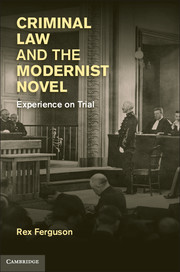
I am very pleased to be able to sing the praises of a new book, with just this title, that has just been published by Cambridge University Press. The book is by Rex Ferguson and explores the relationship between literary and legal modernism, looking in particular at the work of EM Forster, Marcel Proust and Ford Madox Ford. I also have to declare an interest here: I was lucky enough to be one of the supervisors of the original PhD which the book is based on, and feel a tremendous sense of vicarious pride at seeing the work in print.

The central claim is simple enough. The modernist novel was based, amongst other things, on a sense of the unreliability of memory or the inability to reconstruct reality. The omniscient external narrator of the Victorian realist novel was replaced by unreliable narrator of the modernist novel. Experience, as a source of access to reality was undermined or questioned. And this, it is argued, was not simply something internal to the novel, but was a response to a broader social and cultural crisis at the turn of the twentieth century.

This much seems clear in relation to the novel (though to state it so briefly is to fail to do justice to Ferguson's argument), but what does it have to do with law? The life of the law, as Oliver Wendell Holmes famously asserted, is experience, and criminal trials, in particular, claim the ability to reconstruct events as they really happened on the basis (amongst other things) of the experience of witnesses. Did criminal law and theories of evidence and the trial remain completely untouched by the advent of modernism and this crisis of experience?

Ferguson's major contribution in his book is to show that they did not; indeed it is hard to imagine how they could have done, even if the law's self image is one of continuing (not to say overweening) self-confidence in its traditional procedures for establishing proof. In his careful analysis of forensic developments of the early twentieth century - fingerprints, graphology - Ferguson shows how the law sought new forms of reliable evidence to supplement or supplant the unreliable testimony of witnesses. And most importantly he suggests that the establishment of Courts of Appeal able to review and overturn the verdicts of trial courts (in England and Wales in 1906 and in Scotland in 1926) was a response to the same crisis that gave rise to the modernist novel - the recognition of the potential fallibility of the criminal trial and its truth finding procedures.

And lest this sound unduly esoteric to some readers, we should note that this is an argument with huge contemporary relevance. As I have noted in earlier posts, Lord Carloway and the Scottish Government are currently proposing the abolition of the requirement of corroboration. Their argument (in somewhat condensed form) is that far from enabling the establishment of truth, the requirement of corroboration stands
in the way of truth, preventing prosecutions where we (the Crown, the police) know that someone is really guilty. This is a claim that is based on certain unexplored assumptions about truth and how we access it - notably that certain bodies possess a kind of professional experience which give them a superior access to truth, and that the criminal trial should mirror this in some way. (And that legal procedures or safeguards block access to truth rather than being central to the process of establishing it).


Irrespective of the rights or wrongs of Carloway's view, what is important here is that we should be examining the assumptions which underlie his position - precisely the sort of full investigation and debate which the Scottish Government seems to want to avoid. The value of  Ferguson's book is that it addresses precisely these kind of underlying questions about trust in experience, and the place for legal safeguards as a response to uncertainty.

Monday, 9 September 2013

On the Criminal Justice (Scotland) Bill

Earlier this summer the Scottish Government published a draft Criminal Justice Bill. Much of the content of this Bill had been trailed in advance. Broadly speaking the Bill is seeking to implement the findings of the Carloway Review, which in turn was a response to the decision in the case of Cadder which held that the Scottish practice of allowing the police to detain and question suspects for a period of up to 6 hours without access to legal advice or assistance (itself created by an earlier Criminal Justice (S.) Act in 1980) was inconsistent with the European Convention of Human Rights.

Lord Carloway
Much of the Bill seems entirely sensible and broadly consistent with the recommendations of the Carloway Review and largely positive responses to the review: it accordingly reforms the law relating to powers of arrest, sets the period for which a person may be held in custody following arrest, and sets out the right of access to legal advice. The more controversial part of Bill relates to the proposed abolition of corroboration (ss.57-61).

For those not familiar with Scots law, the rule is basically that the proof of any essential fact in a criminal trial needs to be supported by two independent sources of evidence. The origins of this rule can be traced back to medieval canon law, as a response to the abolition of trial by ordeal in the thirteenth century, and it was essentially an attempt to quantify the amount of evidence required for a conviction. Most modern systems of criminal law have long since departed from any requirement of corroboration, preferring instead to rely on understanding of the weight and reliability of evidence (more or less the idea that a case should not necessarily fail where there is one strong piece of evidence from a reliable source but no second piece of corroborating evidence). Scots law, by contrast, has not only retained the rule, but for long time also trumpeted it as an indication of the high level of protection given to an accused person under Scots law.

Now irrespective of the pros and cons of the debate about corroboration, it seems clear that if you are going to abolish a rule that is said to provide protection to an accused (and this in response to a decision which directly challenged Scots law over the strength of protections given to an accused in respect of legal advice on arrest), you need to put a robust new system of protection in place. So what does the Bill offer?

The answer is hidden away in s.70:
A jury of 15 members may return a verdict of guilty only if at least 10 of them are in favour of that verdict.
This is a change from current law, where a person can be convicted on a simple 8:7 majority (which, incidentally, has never seemed like much of a protection to me). But how strong a protection is this? One possible measure is to compare this to the majorities required in other jurisdiction that use juries (and here I am pleased to plug the work of my colleagues, James Chalmers and Fiona Leverick, who have looked into this). And the shocking finding here is that most lay jury systems worldwide typically require either unanimity or near-unanimity in order for an accused person to be convicted. They conclude:
the effect of the Criminal Justice (Scotland) Bill as it now stands would be to reduce the level of protection against wrongful conviction offered in Scotland below that offered in any other comparable jurisdiction.
Scottish Justice Secretary Kenny MacAskill:
Corroboration should be abolished...
It is obviously to be hoped that the Scottish Government will take this criticism seriously. It is not a knee jerk reaction to proposals for the abolition to abolish corroboration, but is based on research and extensive comparative knowledge of criminal justice systems. But the signs are perhaps not great. Similar research based criticisms were made of Lord Carloway's argument about corroboration in his report, but these were never addressed. And now the Government seems to want to press ahead with the abolition of corroboration notwithstanding the disquiet expressed by many. The legislative process is committed to public consultation and review, but if the responses to this review are not taken into account we would be entitled to ask whether this commitment is purely cosmetic.

[Our full response to the Bill, and a link to the published findings of Chalmers and Leverick on jury majorities can be found here]

Tuesday, 3 September 2013

On criminal codes

When we think of criminal codes it is normal, at least for me, to think of the great codifications of criminal law that took places from the late eighteenth and nineteenth centuries. But of course there is another sense of 'criminal code' - that of a code for criminals - and this is perhaps why the former sort are often referred to as penal codes (though this is confusing as they do not only detail punishments, but also codify forms of permissible and impermissible conduct). The relationship between crime and punishment in the modern criminal law is a complex one, and is a topic that I  shall return to in future posts, but for now I want to say something about criminal codes as codes for criminals.

The thought is prompted by the death of the famous crime writer, Elmore Leonard, last month. As a notable
stylist, he is well known for his 10 rules of good writing (the writer's code). Slightly less well known are his rules for successful armed robbery (from the novel Swag). These are:
1. Always be polite on the job, say please and thank you. 
2. Never say more than is necessary. 
3. Never call your partner by name – unless you use a made-up name. 
4. Dress well. Never look suspicious or like a bum. 
5. Never use your own car. 
6. Never count the take in the car . 
7. Never flash money in a bar or with women   
8. Never go back to an old bar or hangout once you have moved up. 
9. Never tell anyone your business. Never tell a junkie even your name. 
10. Never associate with people known to be in crime.
All of this seems eminently sensible - and of course in the novel things start to go wrong for the protagonists when they start to ignore their own rules.

While I don't want to encourage crime, it does make me wonder what other rules for the successful commission of crime we might come up, based on what seem to be common errors. Here is a start on my alternative criminal code (based on cases I have read about):
  • If you are fraudulently claiming disability benefit, it is probably better not to participate in a 10K race; and if you must, try to avoid having your picture taken at the finishing line.
  • If you are planning to poison someone do not tell the chemist that the poison you are buying is to kill rats, especially if there is not trace of a rodent problem at your home.
  • Most people offering their services as contract killers on the internet are probably undercover police officers (from the recent Canadian case of Ryan)
  • If the you and your associate in crime are arrested, it is best to avoid discussing your exploits within earshot of the police.
If you know of other rules, please add them below.

Monday, 1 July 2013

On holiday

Thanks to everyone for your support over the last 12 months. I am now on holiday and will resume posting on the blog in September 2013

Tuesday, 25 June 2013

On imprisoning bankers

The Report of the UK Parliamentary Commission on Banking Standards made a bit of a splash last week, with a lot of the media attention focusing on the proposal to create a new criminal offence of reckless misconduct in the management of a bank (see volume II chapter 10), which might ultimately lead to bankers being sent to prison. It is seen as important, in the words of the report, that there be "robust tools for holding those responsible to account and imposing appropriate penalties".


It is undoubtedly the case that there is a certain populist appeal  to this kind of proposal. After all, as banks like RBS and HBOS were exposed as having run huge financial risks and being on the verge of collapse, there was a lot of public anger directed at those individuals who were perceived to have mismanaged the institutions. Fred Goodwin's Edinburgh home was attacked and he was ultimately stripped of his knighthood. A new criminal offence would play well with the public discontent with the conduct of the big banks. And there is a kind of schadenfreude involved as well. For years, critical criminologists have complained that certain kinds of minor property or street crime are sanctioned more heavily than the more serious financial wrongs committed by those such as bankers or financial institutions - yet they continue, not only to get away with their financial 'crimes', but also to be handsomely rewarded, while petty thieves are relentlessly prosecuted. As the celebrated title of one book has it: the rich get richer and the poor get prison.


The arguments given in favour of individual criminal responsibility are as follows:
  • That the existing sanctions regime (ineffective as it is) is directed at institutions rather than individuals, but that certain individuals play an important role in determining the policy and culture of the institution.
  • That the potential harms created are public harms rather than private harms (i.e. internal only to the banks) because of the damage to market confidence and the use of public funds to bail out the banks
  • That criminal sanctions could act as a deterrent to individuals, and that this could alter the conduct of the institution as various responsible individuals made more effort to supervise the conduct of those under their direction.

However, as the report itself notes, enforcement agencies already experience huge difficulties in establishing any kind of fault. In the words of one witness, Tracy McDermott, talking about previous investigations:
    We invested a significant amount of time and resource into the investigations we did into the failed banks, but we were not able to establish the evidence necessary to take regulatory action, so even if there had been a criminal offence on the statute book, that would not have got us there ... If the evidence is not there, it will not be there for criminal cases in the same way as it won't be there for regulatory cases. You can debate whether we got that call right or wrong, but ultimately the evidential standard is higher in criminal cases
There are a number of reasons given for this: the standard of proof in criminal cases is higher than in civil cases; a successful criminal investigation requires huge resources to filter the enormous number of documents, which regulators or prosecutors do not possess; and, crucially, responsibility is diffused in large organisations, with few (if any) individuals have direct oversight or knowledge of all decisions that are taken.


Any new criminal offence is, thus, likely to face a number of potential difficulties. What about the offence proposed by the Commission?

The proposed offence would  be that of reckless misconduct in the management of a bank. There are a number of features to note about this. The first is that this requires 'misconduct'. Thus while the need for an offence is framed in terms of the harm caused, on the face of it this does not require any actual harm, only misconduct (and presumably potential harm). This might make it easier to prove as it would not be necessary to show that the conduct led to the specified harm.  However, what is required is presumably some conduct that is a clear departure from 'normal' management practices, and a lot would rest on how these were defined or understood.

The second point to note is that the crime is 'reckless' misconduct. This would mean, according to the Commission, that the normal criminal law standard of subjective recklessness should apply. While this may be preferable to a strict liability offence or an offence of negligence, it would be hard to prove. Proof of recklessness in English law requires proof that the person charged was aware of the risk and that it was unreasonable in the circumstances for them to take that risk. This may give rise to two significant problems. First, in a large and complex organisation, it is notoriously difficult to establish who was aware of what, as decisions are delegated or taken by committees. The Commission attempt to get around this by stressing that the important factor is whether or not a manager or director should have been aware of the conduct of those under their charge - the so-called accountability structure - but this may conflict with the criminal law standard of subjective awareness. The second difficulty will be that of establishing what is unreasonable in the circumstances. Is this unreasonable by the standards of the average banker? If this is the case, if the culture of the banks is 'out of control' it may be hard to establish unreasonableness because the defence will be that other banks were doing the same thing - and that the conduct was therefore reasonable. It may be that this would catch only clear or egregious cases of misconduct - which might very well already be criminal under the laws of fraud, market abuse or insider dealing anyway.


So where does this leave us? The Report is recommending the creation of an offence that is to be used only in rare cases where the most serious harm has resulted as a result of (presumably serious misconduct). It will have a high standard of fault, and therefore be difficult to prove, to cover situations where it is already conceded that it is difficult to meet even the lower civil standard of proof in enforcing regulations. It is, then, to imagine that we will see any bankers being jailed any time soon.

Of course, it might then be replied that the point is to show that the criminal law reaches these areas - that no one, not even bankers, is above or beyond the law. This might be important as a kind of symbolic politics, but it is surely pointless to create new criminal offences that clearly overlap with existing offences and which have little prospect of successful enforcement. There is undoubtedly a case for a creating a meaningful sanction regime in this sector, which would include criminal penalties, but this proposal does not make that case.


Tuesday, 11 June 2013

On Trust and Violence

I have spent a lot of time of the past few months reading and thinking about a fascinating book called Trust and Violence by Jan Philipp Reemtsma. It is not directly about criminal law, or even about law at all (except indirectly), but it raises a lot of important questions about the role (and limits) of institutions such as the criminal law in modern society.

Reemtsma identifies three central questions. First, how does modern Western society legitimate the use of violence, and what was distinctive about the way that it did so? Second, how does this culture reconcile its self image of decreasing violence with the actual violence that it produces? And third, why is it that the violence excesses of the twentieth century - the holocaust, the Stalinist purges, wars - have not prompted us to abandon the project of modernity altogether? It became commonplace to ask how we could go on after atrocities on this scale. Reemtsma's response is to raise the flip side of this question: given that we did go on, and continue to go on in spite of these outbursts of extreme violence, what were the kind of social mechanisms and institutions that made this possible?

His answers to these questions are wide ranging. He discusses literature, history, social theory and more. And the text is challenging, but worth the effort. I can't really do justice to the complexity and richness of the argument, so I shan't try here, though I will try to discuss it in relation to specific topics in later posts. 

For now, let me leave you with this video of a talk he gave at University College Dublin. 


Tuesday, 14 May 2013

On The Fine Art of Strange Crimes


Welcome to the city of Red Wheelbarrow, where the world's greatest detective has yet to meet the crime he can't solve—every criminal in Red Wheelbarrow is caught and convicted thanks to Detective Gould's brilliant mind and cutting-edge spy technology.


But lately there has been a rash of crimes so eccentric and random that even Detective Gould is stumped. Will he discover the connection between the compulsive chair thief, the novelist who uses purloined street signs to write her magnum opus, and the photographer who secretly documents peoples' most anguished personal moments? Or will Detective Gould finally meet his match?


This is a wonderful, and wonderfully engaging take on the tradition of the hard boiled detective. In this world it is the art of theft, as much as the theft of art, that is important. And this poses a different kind of challenge to the indefatigable Detective Gould. But my favorite part is the interrogations, as suspect and detective engage in metaphysical and political discussions of the nature of crime.


Well worth a look.