Oblique intent

Why the name? Well criminal law afficionados will recognise the phrase 'oblique intent' as referring to a problem of mens rea:can a person who intends to do x (such as setting fire to a building to scare the occupants) also be said to have an intention to kill if one of the occupants dies? This is a problem that has consumed an inordinate amount of time in the appeal courts and in the legal journals, and can be taken to represent a certain kind of approach to legal theory. My approach is intended to be more oblique to this mainstream approach, and thus to raise different kinds of questions and issues. Hence the name.

Monday, 4 November 2013

On witnesses and veils

The question of whether or not women wearing veils should be permitted to testify has been rumbling on for some time in Britain. Yesterday we were treated to the views of Ken Clarke, Minister without Portfolio in the Coalition government, and former Justice Secretary and criminal barrister. According to Clarke, a proper trial is impossible if a witness is wearing "a kind of bag". He went on
I think the judge and jury have got to see the face of the witness [to] judge their demeanour and decide for themselves whether they are going to rely on this evidence ... It may be you have to make some special arrangements, it may be they'll have to be some screening from the general public, but I actually think it undermines a trial.
Ken Clarke, in costume
Leaving aside his cultural insensitivity (a kind of bag?), it is worth pausing for a moment on the claim which underlies these views. It is the following: that judges and juries can, if they can see a witnesses face, tell whether or not they are lying. If this is correct, then it would appear that there is some scientific basis for this position, and that the law, backed by science, would be justified in asserting its authority over religious and cultural practices which hindered or obstructed the discovery of truth.

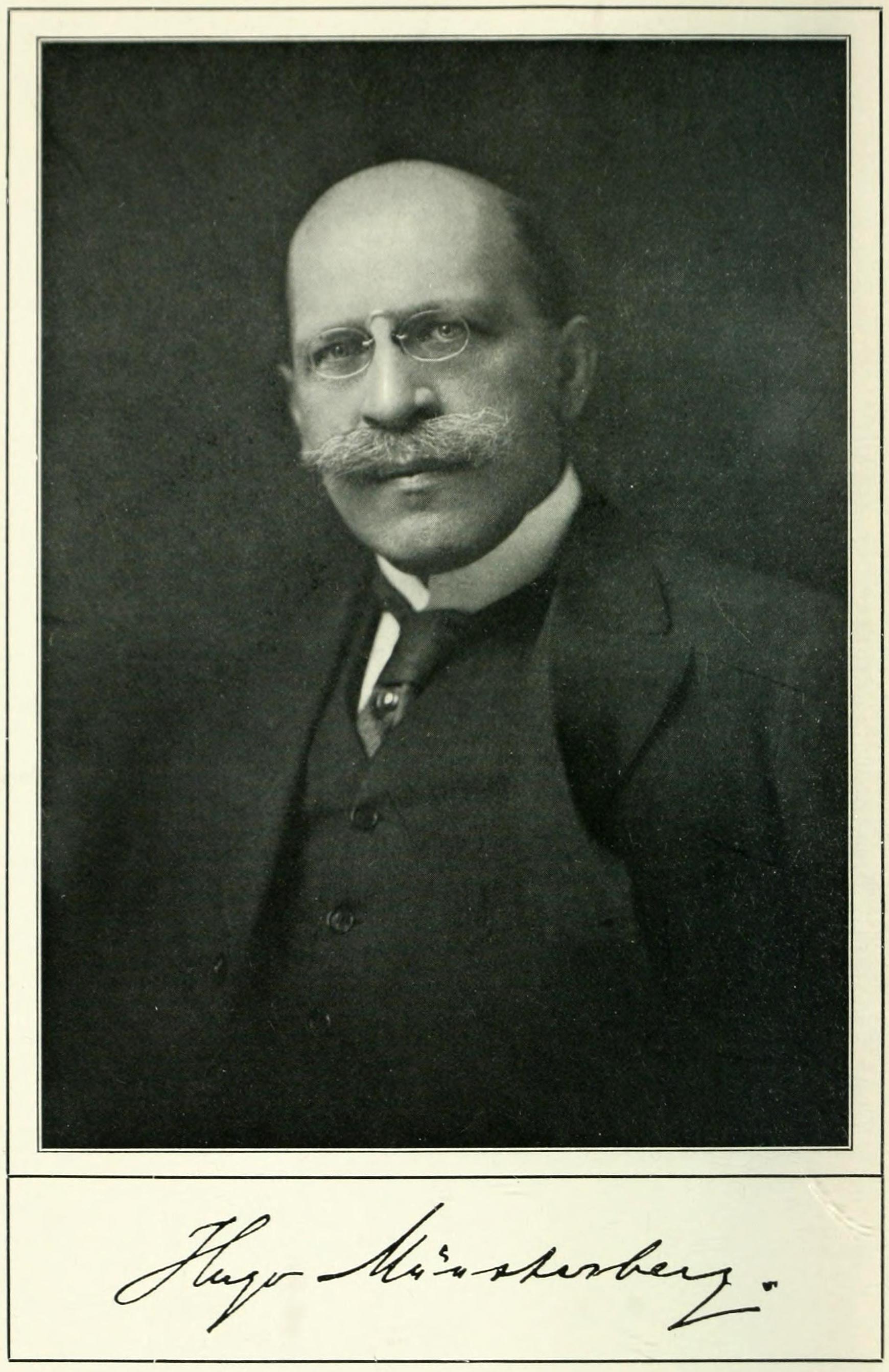
Unfortunately there is little psychological evidence to support these claims. Indeed, studies which have been carried out in this area suggest that professionals (police, immigration officers) are no better at detecting lies than the ordinary person, and that the ordinary person does no better than 50:50. (The suggestion is that poker players may be the best at detecting lies...). There is, of course, a huge amount of folk belief in this area, a lot which can be traced back to ancient superstitions about guilt or unreliability revealing itself through signs: sweating, failure to make contact, nervous tics and so on. These are entertainingly discussed in a famous work by Hugo Munsterberg, one of the pioneers of criminal psychology, called On the Witness Stand (1908). But while claiming the existence of these 'tells', even Munsterberg acknowledged that further psychological research was needed in order to learn properly how to detect them.

In the continuing absence of convincing findings, the claims of lawyers (and politicians) as to the lie detecting powers of judges and juries are no more than folk beliefs. Video or audio evidence is just as likely to produce the same outcomes, and from a scientific perspective there may even be no good reason why we should not rely on written evidence. And whether witnesses given evidence from behind screens or veils, or from a different room should not really have much impact on the ability of the jury to detect whether they are lying or telling the truth.

So what is really going on here. A more plausible way of understanding what is at stake is in terms of confrontation. This is the belief that the trial is at base about bringing the main protagonists together and that the truth will emerge from a series of confrontations: between the accused and their accusers, the lawyer and the witness, between lawyer for the prosecution and defence. This is bolstered by the mythology of the adversarial trial: stories of brilliant barristers breaking down witnesses, of accused persons cracking under sustained cross examination, of the coup de theatre that undermines a key witness. This is the British way of justice, but the audience is less the jury than a broader public who are to be convinced of the reliability of our institutions of justice and those who work in them.

And this is the point: what is really at stake is a clash between the sense of the trial as an event and something which might undermine this. The witness in a veil is seen as undermining this without good reason (though of course there are many excellent reasons for respecting cultural difference). It really has nothing to do with truth, and it would be better for all if this were recognised from the start.

Friday, 25 October 2013

On pumas and Scots criminal law

In March 1976 the landlord of a bar in Leith, Edinburgh was charged in the following terms:
[that he did] keep and allow to go at large, without being under any appropriate care, restraint or control, a puma belonging to (him) or under (his) charge, or in (his) possession, while members of the public were in said public house, and said puma attacked and injured (X and Y) and did recklessly disregard the lives and safety of the public.

The puma in question was apparently normally kept in a cage in the lounge bar (not the public bar). It had apparently at some point been released from its cage by the landlord and had attacked two persons who, according the report, "had previously been asked to leave the premises". The Sheriff convicted the accused of the charge, apparently on the grounds that a puma might be distinguished from domesticated animals kept as pets because it had the
"instincts and unpredictable impulses of a wild animal, rather than a domestic dog, in which ferocity may be a manifestation of its propensity to protect its master's person, property or territory"
Moreover, the fact that the accused had released the puma was evidence of a recklessness towards the safety of others (!).

It would be nice to report that the cases led to the refinement of some legal principle, but unfortunately that is not the case. The landlord appealed against the conviction but, for reasons which have not been recorded, the appeal was dismissed.

An Italian restaurant on the site
of the original Fairley's
For some reason I have not heard of this case before, but it surely deserves to be better known. The decision was not reported, though there a short report in the Journal of Criminal Law (1977 41 J Crim Law 57 for those how have access to the journal). Presumably there was some coverage in the local papers at the time (it is hard to imagine they would ignore it) though I have not had time to check. There is, however, some further information here, which paints an interesting picture of Leith in the 1970s - and raises the possibility that the puma was not the wildest occupant of Fairley's at the time.


Wednesday, 16 October 2013

On Bentham on pederasty (or offences against one's self)

One of the delights of the internet is that it is a treasure trove of obscure or little known documents, access to which would previously only have been open to those with very good libraries - or the time and resources to travel to those libraries. So it was that while I was that, while I was looking for information on Jeremy Bentham's theory of codification, I discovered this fascinating document: Bentham's essay on pederasty, or offences against one's self.

Jeremy Bentham
I have written on Bentham before - about his general theory of criminal law and punishment - but this shorter essay culled from amongst his voluminous unpublished writings is something else altogether. The general approach is in line with his attitude towards the common law and his project of reclassifying the criminal law, but the text, and its history, are revealing in other ways.

In this essay, which was written around 1785 but never published in his lifetime, Bentham examines the justifications given for the criminalisation of so-called "unnatural offences", principally the sexual offences of sodomy, bestiality and masturbation, and the severe punishments which attached to these crimes. He argues that there is little or no evidence that they harm either individuals or society and that there is no possible justification for harsh punishments imposed by the law.

He systematically works through the reasons that have been offered in support of these crimes by a series of distingushed writers, from William Blackstone, to Montesquieu to Voltaire, and dismisses them in turn as riddled with inconsistencies and prejudices and having no possible rational basis.

Thus, there is no evidence that the conduct produces pain; rather it produces pleasure. It cannot be an offence against security or the peace (Blackstone), if it is practised with consent. It cannot hurt the population (Voltaire), or rob women of their rights (!) or be harmful to marriage. And indeed, he asks, if homosexual sex is regularly practised on what basis can it be termed unnatural? The justification for such offences, he concludes seems to lie in a hatred of pleasure, rather than in any possible harm caused by the conduct itself, a position which has been set up by the "prejudices of false philosophy and the terrors of a false religion". In place of this, he argues that on the principle of utility  he argues that there is no justification for these offences (although he does recommend "domestic discipline" as a remedy for for the pernicious and enervating effects of masturbation).

This, then, is a fascinating document, both ahead of its time and strangely of its time. It is ahead of its time as the first known argument for reform of the law of homosexual offences in England, and it demonstrates as characteristic clarity of purpose and rhetorical flourish in its critique of existing criminal laws. It is also strikingly contemporary in its classification of such offences as "offences against one's self" - and thus not to be criminalised in the absence of either harm to oneself or others (or social harm). In this it prefigures the better known work of his pupil, John Stuart Mill, who set out what has come to be known in modern thought as the harm principle: that criminalisation without harm was unjustifiable. And it is also modern in its critique of criminal laws based on moral beliefs or prejudices, and in its aim of replacing prejudice with laws based on reason.

But at the same time it appears very much of its time. This is nowhere more apparent than in the title.  Pederasty for Bentham was the term for consenting homosexual intercourse between men (the term homosexual was not coined until the work of Kraft-Ebbing in the late nineteenth century, and pederasty did not acquire its specifically contemporary meaning of sex between a man and a boy until later). Consistently with this, his examples of the permissibility (and non-harmfulness) of homosexual sex were drawn principally from classical sources. But most notable of all is the tone of the essay, which would sit uncomfortably with modern arguments for law reform. Bentham makes little effort to hide his distaste, repeatedly referring to the perverted tastes of those who engage in such conduct. Indeed, the tone of the essay as a whole struggles to reconcile his arguments about a rational approach to the law with his personal beliefs about homosexual conduct.

And this brings us to the question of why it was not published. It was apparently originally conceived as part of the schema of classification contained in his book On the Principles and Morals of Legislation, one of his few major works that was published in his lifetime. In this book Bentham
proposes a new scheme for the classification of criminal laws that would be consistent with his utilitarian principles (see ch.16). In place of the categories of the common law he proposed a more rational schema based around the interests to be protected by the law, moving from offences against individuals (person, reputation) to objects associated with persons (such as property), to various kinds of public offences (including offences against the positive increase of the national felicity...). And he sought to examine existing laws to see how they would fall within his new classification - either being reclassified or abandoned altogether.

It is easy to see how the essay fits in this schema. But at the last moment it appears that he blanched at publication of this section. According to the editor of this published version, his notes reveal that hee feared that this was a step too far, that it would be damaging to his reputation to be associated with these beliefs, to appear to support homosexual conduct. And so the essay was quietly shelved

So it appears that Bentham the iconoclast, the attacker of irrational beliefs and sacred cows, was not without his limits after all. But if this disappoints, we should be grateful that this work is now freely available, for it offers fascinating insight into both the his beliefs and the mores of his time.


Wednesday, 9 October 2013

On the Appin Murder (1752)

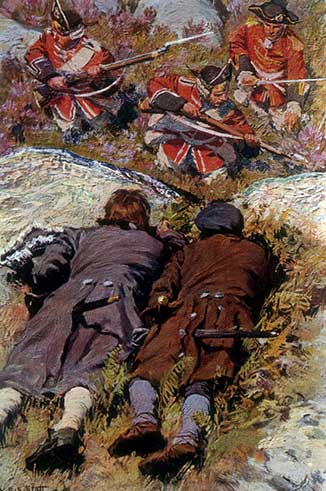
I have been struggling to know what to make of this story - the apparent attempt to re-try James Stewart, convicted and hanged for the murder of Colin Campbell in 1752 (better known as the Appin Murder). A team of modern day forensic experts re-examined the evidence, relating to ballistics etc, before a retired senior judge, and a jury of the public were asked to determine guilt.

Not surprisingly, for it is widely accepted that he was made a scapegoat for the killing, they concluded that James Stewart must have been innocent, and that Alan Breck Stewart (the main suspect, who James Stewart
was charged with abetting) could not be held responsible in the absence of evidence as to his whereabouts at the time. Indeed they conclude therefore that if there was no clear evidence that Breck Stewart committed the crime, then James Stewart could not have abetted its commission, and that there was no basis for an indictment against him.

But this is hardly news. The trial is a notorious miscarriage of justice: a politically motivated trial aimed at suppressing dissent in the turbulent period following the 1745 rebellion. James was scapegoated, a convenient target for the authorities because he was known to have quarreled with the victim and was, moreover, a leading member of the rebellious local Stewarts. The trial was held in Campbell country - Inverary - before an unsympathetic judge and jury. Legal argument was limited and legal niceties such as doctrines of complicity were brushed aside in the rush to obtain a conviction. Moreover, there was nothing that we would understand as forensic evidence, and the kind of legal protections that we take for granted today were considerably less robust. So it is hardly surprising that, judged by modern standards of forensic evidence and criminal procedure, the outcome is found wanting. So why do it


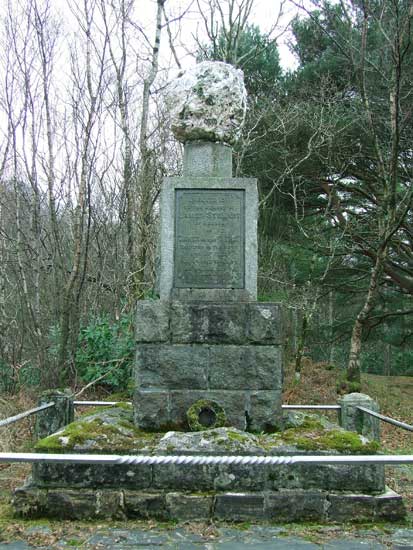
James Stewart's Monument,
Ballachulish
Perhaps the only novel finding is that the two shots which were fired came from two different muskets, rather than a single one, as had usually been assumed - a finding which resonates in a strange way with contemporary conspiracy theories about multiple shooters of President Kennedy in Dallas. But this does not help to identify the shooter, or tell us if Breck Stewart fired one of the shot. It is, though, consistent with the idea that there was a planned element to the attack, as the two shots must have been fired more or less simultaneously as witnesses reported hearing a single shot and it was long assumed that the two musket balls found in the victim had been shot at the same time from the same gun. This underlines the theory that the attack was motivated by political discontent - as we knew anyway - though this still does not support any assumption that James Stewart was involved.

Robert Louis Stevenson

The case clearly fascinates - though it is likely that few would have heard of it today were it not for the brilliant novels of Robert Louis Stevenson (Kidnapped and Catriona) which took the case as their backdrop.
Even in these works Stevenson is careful to hedge his bets - while he seems to suggest that Breck Stewart is responsible, he does not go so far as to depict him actually pulling the trigger, and in other respects paints him as a romantic rebel with whom the reader sympathises. And as befits someone who is known to have read the legal account of the trial (and was trained as a lawyer) he does not pretend that the trial was fair - and even without the benefit of contemporary forensic evidence he is able to lay bare the injustice of the outcome.

So faced with these alternatives it is surely better by far just go and read the novels - for which we surely need no excuse.


Thursday, 26 September 2013

On Crime in 1946

This is a link to a long article that I really like. The writer, Duncan Campbell, asks whether crime in 1946 had certain characteristics - a question prompted by a review of three books about notorious crimes committed in that year.

It seems clear that different periods see certain crimes and trials as emblematic, as capturing some features of a particular moment. Crimes and criminal trials are often seen as offering a kind of unique perspective on society. The trial offers a moment of introspection, inviting observers to reflect on the state of the nation. And certain crimes are also seen as epochal - though this can often be judged only in retrospect - revealing the emergence of new kinds of criminality. Most notoriously, the Jack the Ripper crimes are seen as the the origin of the modern serial killer, but even in less dramatic form it is possible to see new crimes or shifts in the ways that crimes are committed.

Neville Heath
Does it also reveal something about the state of the criminal law? I suspect that it does. New offences are created in response to particular crimes or moral panics. But I suspect that more than that might be going on as well. There might be two ways of thinking about this. On the one hand it is important to look at patterns of prosecution: why, given the multitude of crimes on the books, are certain crimes prosecuted in certain periods and not in others? Campbell's account points to the significance of crimes like bigamy, rarely prosecuted these days, but easily committed in a time of social flux at the end of the war when people could perhaps move around and drop social connections and fashion new identities more easily than is possible now. Also important, though, was the transition from wartime laws and regulations to a more settled state of law and order - when certain kinds of illegality were tolerated differently.

People like Neville Heath were able to exploit the uncertainties in the legal order. Although the wartime period saw intense regulation of food production and the management of resources, there was also a widespread black market, the existence of which was tolerated in many areas - at least until the end of the war. There were many homeless people, or those who had lost their papers, as a result of bombing, and these mingled with those, such as Heath or Hagger (also mentioned in the article) who were deserters and had reason to conceal their identity. And of course there was a general sense of insecurity brought on by the war and its consequences that the institutions of social order, such as the criminal law were struggling to rebuild. This was, no doubt, not as dramatic as in, say, Berlin at the end of the war, where contemporary accounts suggest the existence of a more radical kind of lawlessness, but there was unquestionably a different degree or kind of social and civil order from that which is familiar to us today. And this offered opportunities and new kinds of vulnerabilities, as the stories told by Campbell make clear.

This raises much bigger questions about the relationship between criminal law and social and civil order, which I hope to return to at some point soon.

Tuesday, 24 September 2013

On the criminalization of HIV transmission


This is just a brief follow up to earlier posts on the impact of criminalization of HIV transmission. This video is a fascinating review of much of the social science research that has been carried out on the negative impact of the criminal law in this area.

[I am having problems uploading the video, so for now here is a link and I hope to sort this shortly]

It is a depressing story, but the central message is very clear: criminal law measures which are aimed at reducing the harm of HIV transmission by seeking to deter risky conduct by the threat of sanctions are having the opposite effect in this area.

Tuesday, 17 September 2013

On Criminal Law and the Modernist Novel

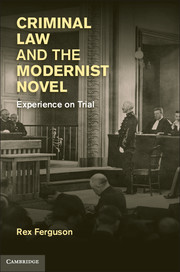
I am very pleased to be able to sing the praises of a new book, with just this title, that has just been published by Cambridge University Press. The book is by Rex Ferguson and explores the relationship between literary and legal modernism, looking in particular at the work of EM Forster, Marcel Proust and Ford Madox Ford. I also have to declare an interest here: I was lucky enough to be one of the supervisors of the original PhD which the book is based on, and feel a tremendous sense of vicarious pride at seeing the work in print.

The central claim is simple enough. The modernist novel was based, amongst other things, on a sense of the unreliability of memory or the inability to reconstruct reality. The omniscient external narrator of the Victorian realist novel was replaced by unreliable narrator of the modernist novel. Experience, as a source of access to reality was undermined or questioned. And this, it is argued, was not simply something internal to the novel, but was a response to a broader social and cultural crisis at the turn of the twentieth century.

This much seems clear in relation to the novel (though to state it so briefly is to fail to do justice to Ferguson's argument), but what does it have to do with law? The life of the law, as Oliver Wendell Holmes famously asserted, is experience, and criminal trials, in particular, claim the ability to reconstruct events as they really happened on the basis (amongst other things) of the experience of witnesses. Did criminal law and theories of evidence and the trial remain completely untouched by the advent of modernism and this crisis of experience?

Ferguson's major contribution in his book is to show that they did not; indeed it is hard to imagine how they could have done, even if the law's self image is one of continuing (not to say overweening) self-confidence in its traditional procedures for establishing proof. In his careful analysis of forensic developments of the early twentieth century - fingerprints, graphology - Ferguson shows how the law sought new forms of reliable evidence to supplement or supplant the unreliable testimony of witnesses. And most importantly he suggests that the establishment of Courts of Appeal able to review and overturn the verdicts of trial courts (in England and Wales in 1906 and in Scotland in 1926) was a response to the same crisis that gave rise to the modernist novel - the recognition of the potential fallibility of the criminal trial and its truth finding procedures.

And lest this sound unduly esoteric to some readers, we should note that this is an argument with huge contemporary relevance. As I have noted in earlier posts, Lord Carloway and the Scottish Government are currently proposing the abolition of the requirement of corroboration. Their argument (in somewhat condensed form) is that far from enabling the establishment of truth, the requirement of corroboration stands
in the way of truth, preventing prosecutions where we (the Crown, the police) know that someone is really guilty. This is a claim that is based on certain unexplored assumptions about truth and how we access it - notably that certain bodies possess a kind of professional experience which give them a superior access to truth, and that the criminal trial should mirror this in some way. (And that legal procedures or safeguards block access to truth rather than being central to the process of establishing it).


Irrespective of the rights or wrongs of Carloway's view, what is important here is that we should be examining the assumptions which underlie his position - precisely the sort of full investigation and debate which the Scottish Government seems to want to avoid. The value of  Ferguson's book is that it addresses precisely these kind of underlying questions about trust in experience, and the place for legal safeguards as a response to uncertainty.