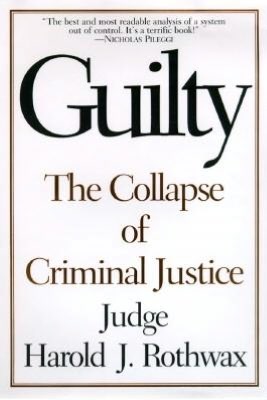
There is a genre of writing about criminal law and the criminal justice system that presents the story of modern criminal justice as one of decline. There was a golden age at some point in the past - though precisely when this was depends on the thesis being advanced in the book - and the subsequent history is presented as a fall from grace. Ideals of clarity, simplicity and justice are departed from as the system becomes increasingly complex and bureaucractised. And the solution is always to go back to the future, a return to the model of the past as a way of moving forward.
An excellent example of this type of narrative is William Stuntz's The Collapse of American Criminal Justice (2011), a work which has been highly praised by reviewers. The diagnosis of the ills of the system is a largely familiar one. It is highly discriminatory against poor and black individuals and communities; punishments are increasingly harsh; and the rule of law has been increasingly undermined by official discretion in law enforcement - from the police deciding who to stop and search to the use of plea bargaining to replace jury trials, to legislative practices which have allowed the creation of broad offence definitions which ease the practice of enforcement. These three factors interact as discretion reinforces discrimination. These are then read through a historical narrative which tells the story of the departure of criminal justice from Golden (or rather Gilded) Age ideals. Stuntz is too smart to completely romanticise the past, but he still anchors the account in an appeal to simpler times.
These simpler times are seen in what has become known as the 'Gilded Age', roughly between 1880 and 1930. And this is read for two main factors. First, he claims that the system was more democractic, in the sense that there was greater local accountability, and second he argues that this system actually fostered greater commitment to the ideal of equal protection before the law. His account of this is complex and nuanced, but basically boils down to the idea that law enforcement officers lived in the communities where they enforced the law and juries comprised of local citizens had greater freedom to interpret how legal norms could be applied then this represented a check on state power, which was gradually undermined as the system was bureaucratised and made less accountable. More controversially, he argues that the due process reforms of the Warren Court in the 1960s were wrong because they undermined the pre-existing commitment to equal protection before the law.
There is a nostalgia for the past in this kind of thesis, that inevitably underplays certain features of the historical systems in favour of those which are seen to support the argument. However, rather than challenge the history with an alternative interpretation (which I am not sure that I am qualified to do), I am more interested in the structure of the argument. First of all, the nostalgia here, the appeal to simpler times, is deeply conservative. In spite of Stuntz's admission that he is primarily concerned with contemporary problems, this kind of move seems to me to express a desire not to engage with the present, to avoid the complexity of now by turning back the clock. Indeed the argument in the book works best when it drops the historical comparison and simply looks with a critical eye at developments in sentencing or policing. Nostalgia also inevitably underplays the complexity of the past, as we can appeal to an image that reinforces our existing prejudices. There is not a genuine historical interest here, because the argument is already known. And this points to the third move - redemption. We can be saved if we believe, but then the argument is itself predestined.
For some reason this genre seems particularly prevalent in the US - try googling collapse of american criminal justice and see how many examples come up. This may just be because dramatic titles sell books (collapse, decline, fall, death), but it probably also connected to something deeper. There is a lingering distrust of the state, evidenced in the faith in the original words or motives of the framers of the constitution, or the persistent desire to see their political system through the lens of de Tocqueville (a French tourist who showered it with praise in the 1820s). This might even be seen as a faltering commitment to modernity. Whatever it is, it is important in engaging with this to think not just of content, but also the form in which it is expressed.
This is a blog about the history, theory and practice of the criminal law. I shall write about books, cases, trials, novels that catch my interest, and even occasionally about current events. My aim is not comment on current caselaw or issues in criminal justice, but to rather to develop a more oblique critique of the law.
Oblique intent
Why the name? Well criminal law afficionados will recognise the phrase 'oblique intent' as referring to a problem of mens rea:can a person who intends to do x (such as setting fire to a building to scare the occupants) also be said to have an intention to kill if one of the occupants dies? This is a problem that has consumed an inordinate amount of time in the appeal courts and in the legal journals, and can be taken to represent a certain kind of approach to legal theory. My approach is intended to be more oblique to this mainstream approach, and thus to raise different kinds of questions and issues. Hence the name.
Friday, 26 October 2012
Thursday, 11 October 2012
On the (de-)criminalization of HIV transmission again
It occurs to me that the conclusion to the last post was rather rushed - a bit too oblique, if you like - and that I could have spelled out my concerns in more detail. I am also prompted to do this because I have been shown some further research on prosecutions for HIV transmission in Canada which underlines some of the points I was wanting to make in the post.
Criminalization or decriminalization in this area is always also about the distribution of responsibilities. Does the state take responsibilty for managing public health in this area, or does it pass the responsibility on to others - or does it share the responsibilities in an appropriate way? The use of the law in this area requires us to reflect on what it is that we seek to achieve through the use of the criminal law - the public health dimension, if you like. It is not only a matter of a harm being done to someone (the transmission of HIV), but also of whether the use of the criminal law is the best means of harm reduction. And in a situation where (at least) two people are involved, it is not always going to be easy to point the finger of blame at one of them. Who should take responsibilty for disclosure? Who is expected to take precautions (and who will be prosecuted for the failure to take precautions)? This also relates to our perception of who the victim is in a given situation, and who can be viewed as a perpetrator or which group of people represent a threat.
Answers to these kind of questions are given some content by research which has been carried out on who is prosecuted for the crime of HIV transmission in Canada and for what kind of sexual encounters. There is a lot of fascinating material in the report, but I want to pull out two key findings. These are first that in a high percentage of the prosecutions (40%) no actual HIV transmission had taken place - that is to say that the person was being prosecuted for an aggravated sexual offence where what was at issue was the risk of serous bodily harm. Second, the majority of those prosecuted were heterosexual men (around 70%) - which is to say those who were prosecuted on the basis of a heterosexual encounter - and in the period since 2004 the majority of these were black. In seeking to explain this last finding, the authors of the report make two observations. The first is that this might reflect differences in understandings of and respones to HIV risk between the gay and heterosexual communities. And second, they suggest that heterosexual women, and especially white heterosexual women, who are the complainants in many of these cases better fit police and prosecution conceptions of victims - and so the cases are more likely to be taken up.
The way forward must surely be shared responsibility for the disclosure and for the consequences of non-disclosure. Where no transmission takes place it is hard to see what is achieved through criminal prosecution - other than the reinforcement of prejudice. And even where there is transmission it is hard to see that the criminal law has a role to play, except in cases where this is deliberate and some overt deception or fraud has been used.
Answers to these kind of questions are given some content by research which has been carried out on who is prosecuted for the crime of HIV transmission in Canada and for what kind of sexual encounters. There is a lot of fascinating material in the report, but I want to pull out two key findings. These are first that in a high percentage of the prosecutions (40%) no actual HIV transmission had taken place - that is to say that the person was being prosecuted for an aggravated sexual offence where what was at issue was the risk of serous bodily harm. Second, the majority of those prosecuted were heterosexual men (around 70%) - which is to say those who were prosecuted on the basis of a heterosexual encounter - and in the period since 2004 the majority of these were black. In seeking to explain this last finding, the authors of the report make two observations. The first is that this might reflect differences in understandings of and respones to HIV risk between the gay and heterosexual communities. And second, they suggest that heterosexual women, and especially white heterosexual women, who are the complainants in many of these cases better fit police and prosecution conceptions of victims - and so the cases are more likely to be taken up.
So, if we go back to the discussion of the case, can we draw any further conclusion. It is arguable that the Court was trying to address the first point - decriminalising non-disclosure where there is no significant risk of transmission. But the real risk here is that this aim will be undermined by the lack of attention to the context in which sexual encounters take place and the failure to specify clearly where responsibilities lie. In fact it is arguable that the finding of the case - restoring the convictions against a black Sudanese immigrant where the female complainants testified about their fears - in fact reinforces the prejudices in this area.
The way forward must surely be shared responsibility for the disclosure and for the consequences of non-disclosure. Where no transmission takes place it is hard to see what is achieved through criminal prosecution - other than the reinforcement of prejudice. And even where there is transmission it is hard to see that the criminal law has a role to play, except in cases where this is deliberate and some overt deception or fraud has been used.
Monday, 8 October 2012
On the (de-)criminalization of HIV transmission
The recent judgment of the Supreme Court of Canada in the case of R v Mabior raises some interesting issues about the criminalization of HIV transmission. The case involved a man who was charged with nine charges of aggravated sexual assault under the Canadian Criminal Code for failure to disclose his HIV status to his sexual partners. In this case none of these sexual partners contracted HIV. There was also evidence either that a condom had been used, or that as the man was using retroviral drugs, his viral load was low and there was accordingly a low risk of transmission of the virus. The case accordingly concerned the questions of the degree of risk required to constitute the crime, and of the kind of risk might or might not be consented to and the sort of information that was necessary to make consent real.
He was initially convicted of aggravated assault, but on appeal the convictions were negated on the grounds that the low risk of transmission could mean that the offence had not been committed. The Crown appealed against this and the Supreme Court restored the convictions in four of the cases -where in spite of the low risk of transmission the complainants had testified that had they known of Mabior's HIV status they would not have had sex with him.
The case had been regarded as an important opportunity to reframe Canadian law on this issue. There was evidence to suggest that the level of prosecutions for this offence in Canada was high, and an unease about treating this as a serious life endangering offence in an era where improved drug treatment limited the impact of transmission. It is harder to argue that HIV is life endangering, at least in Canada and other western countries where the availability of retroviral drugs means that the illness can be managed. There was thus an argument that the offence had been drawn on overly broad terms, given its seriousness, and for limiting the role of the criminal law in this area.
The basic Canadian law in this area was established in the case of Cuerrier in 1998. In this case the Supreme Court ruled that failure to disclose that one has HIV could constitute fraud vitiating consent to sexual relations under s. 265(3)(c) of the Canadian Criminal Code and amount to aggravated sexual assault (s.273). (This, I should add, is already a stretch. Section 265 talks about applying force to another, and aggravated sexual assault is defined in terms of wounding, maiming, disfiguring or endangering the life of another - none of which are terms that easily fit in this area). So, in order to establish a conviction, the Crown must show a dishonest act which affected the ability of the complainant to consent (lying about the one's HIV status) and that this endangered life.
The decision in Mabior does not change the basic law in this area - an intentional failure to disclose HIV status can still amount to aggravated sexual assault - but it does try to clarify the circumstances under which discloure of HIV status might be necessary. For the sake of simplicity, the new test can be understood as comprising an objective and a subjective element. Objectively the Court states that in order for it to be necessary to disclose your HIV status there must be a 'significant risk' of transmission. Accordingly, where the risk of transmission is low it may not be necessary to inform prospective sexual partners of your HIV status (though the judgment is somewhat vague here as to whether it is also necessary to use a condom). In the subjective part of the test (which is not so clearly expressed) the Court seems to indicate that consent should be informed - that sexual partners should have the information necessary to enable them to make and informed decision as to consent.
And here we see the problem. While the Court is to be applauded for attempting to restrict the scope of the offence in the objective part, because it is not possible (as they acknowledge) to define the exact level of risk at which disclosure is not required, a lot will then depend on the subjective part of the test. But it is not clear this will limit the offence. In the appeal the convictions were restored because the complainants testified that they would not have slept with him even given the negligible risk of transmission if they had known of his HIV status. The scope of the offence thus depends on the fears of potential victims, apparently even if these are unreasonable - and the laudable aspiration to protect informed consent can quickly collapse into uninformed prejudice. A proper test in this area must be based on something more objective.
He was initially convicted of aggravated assault, but on appeal the convictions were negated on the grounds that the low risk of transmission could mean that the offence had not been committed. The Crown appealed against this and the Supreme Court restored the convictions in four of the cases -where in spite of the low risk of transmission the complainants had testified that had they known of Mabior's HIV status they would not have had sex with him.
The basic Canadian law in this area was established in the case of Cuerrier in 1998. In this case the Supreme Court ruled that failure to disclose that one has HIV could constitute fraud vitiating consent to sexual relations under s. 265(3)(c) of the Canadian Criminal Code and amount to aggravated sexual assault (s.273). (This, I should add, is already a stretch. Section 265 talks about applying force to another, and aggravated sexual assault is defined in terms of wounding, maiming, disfiguring or endangering the life of another - none of which are terms that easily fit in this area). So, in order to establish a conviction, the Crown must show a dishonest act which affected the ability of the complainant to consent (lying about the one's HIV status) and that this endangered life.
The decision in Mabior does not change the basic law in this area - an intentional failure to disclose HIV status can still amount to aggravated sexual assault - but it does try to clarify the circumstances under which discloure of HIV status might be necessary. For the sake of simplicity, the new test can be understood as comprising an objective and a subjective element. Objectively the Court states that in order for it to be necessary to disclose your HIV status there must be a 'significant risk' of transmission. Accordingly, where the risk of transmission is low it may not be necessary to inform prospective sexual partners of your HIV status (though the judgment is somewhat vague here as to whether it is also necessary to use a condom). In the subjective part of the test (which is not so clearly expressed) the Court seems to indicate that consent should be informed - that sexual partners should have the information necessary to enable them to make and informed decision as to consent.
| But is always necessary to use one? |
Thursday, 27 September 2012
On burglary
There have been eyebrows raised in response to the comments of Judge Michael Pert this week. While sentencing two men found guilty of burglary, he said that burglars who chose to burgle homes where the owner legally possessed a gun should accept the risk of being shot. In his exact words:
Further comment then came this morning from Lord Chief Justice Judge, who responded to questions on the case by suggesting that burglary of a home was more than a crime against property, but was also a crime against the person:
At one level this seems intuitively right - even without having to dress it up in the language of the Englishman's home being his castle, and so on. There might be two reasons for this. The first is present in LCJ Judge's statement, but might be spelled out more fully. This is that there is a difference between being in public and private spaces such as the home. When we venture out into public, we perhaps adopt a certain front or persona, we are ready for encounters or engagement with strangers. This might also be true of certain private spaces where we meet others. However, in our home, either on our own or with intimates, we generally do not feel the need to put on that front, unless perhaps we are inviting guests into our space - but even then there might be a different kind of negotiation, as we deal differently with friends or acquaintances and strangers. It is not just a matter of safety or security. One might feel safe in public, and a lot of feminist reserach has documented how for many women and children the home is not a place of safety. It is more that the uninvited entry of a stranger is a particular kind of transgression or threat. Thus at one level this might have nothing to do with property at all. It would be just as much of a threat to find an intruder in a hotel bedroom as in a home that you home. While a burglary of other kinds of buildings or dwellings houses would not be so threatening in the absence of people living there.
The second reason is also hinted at in the Lord Chief Justice's remarks, and is that a burglary might feel like a crime against the person. This might be because while we own or possess different kinds of property, we have a different kind of relation with them. I own some property which is in a sense 'disposable'. If certain kinds of property are taken they are easy to replace, and the lack of police interest, say, in tracking stolen bikes or even cars reflects this to some extent. But there are other kinds of property that might have less intrinsic value, but which have value to me because of their sentimental meaning or because I have worked on them or identify with the property in a certain way, and it would hurt me more to lose or have this stolen. And of course in our culture, our homes represent a particular kind of investment. They are not just a structure in which to eat or sleep, but a particular place in which we ccan decorate and embellish as an expression of our identity - and to which we return at night to recover our sense of self. And it not then surprising that one often finds the victim of burglary reporting the sense of violation that they feel or the loss of a sense of security - the hurt goes far beyond the value of any property taken. So burglary, as with certain kinds of theft, might seem like a kind of invasion of the person.
But we should be careful where we go with this. Should a crime be treated as more serious becuase of the value of the property to the victim? Probably not, though it might at least be arguable that in some cases it might be worse to steal something (even of no value) that you know to be of value to the victim because, say, you want to hurt them.
But what about self defence? The danger of going down this road of seeing threats to property as threats against the person is that we extend the scope of self defence, making it easier to see any intrusion or taking as a threat to self which would justify the use of (possbily fatal) force. It may be that, as LCJ Judge says, homeowners dealing with intruders should not necessarily have to hang around to find out the precise degree of threat offered by that intruder, But at the same time, many burglaries are routine and much of the property stolen is that which is 'disposable' - not easily identifed and quickly convertible into cash (electronics etc). So we should be wary about defining our sense of burglary in terms of what might be an extreme or special case, and we should be especially wary about analogies which make it too easy to extend the scope of self defence.
If you burgle a house in the country where the householder owns a legally held shotgun, that is the chance you take. You cannot come to court and ask for a lighter sentence because of it.
| Joshua O'Gorman and Daniel Mansell, who were shot in the course of burglary |
It's not a matter of being sentimental. When you are at home you want to feel safe. You are entitled to feel safe and secure.
| Sir Edward Coke: "For a man's house is his castle..." |
The second reason is also hinted at in the Lord Chief Justice's remarks, and is that a burglary might feel like a crime against the person. This might be because while we own or possess different kinds of property, we have a different kind of relation with them. I own some property which is in a sense 'disposable'. If certain kinds of property are taken they are easy to replace, and the lack of police interest, say, in tracking stolen bikes or even cars reflects this to some extent. But there are other kinds of property that might have less intrinsic value, but which have value to me because of their sentimental meaning or because I have worked on them or identify with the property in a certain way, and it would hurt me more to lose or have this stolen. And of course in our culture, our homes represent a particular kind of investment. They are not just a structure in which to eat or sleep, but a particular place in which we ccan decorate and embellish as an expression of our identity - and to which we return at night to recover our sense of self. And it not then surprising that one often finds the victim of burglary reporting the sense of violation that they feel or the loss of a sense of security - the hurt goes far beyond the value of any property taken. So burglary, as with certain kinds of theft, might seem like a kind of invasion of the person.
But we should be careful where we go with this. Should a crime be treated as more serious becuase of the value of the property to the victim? Probably not, though it might at least be arguable that in some cases it might be worse to steal something (even of no value) that you know to be of value to the victim because, say, you want to hurt them.
But what about self defence? The danger of going down this road of seeing threats to property as threats against the person is that we extend the scope of self defence, making it easier to see any intrusion or taking as a threat to self which would justify the use of (possbily fatal) force. It may be that, as LCJ Judge says, homeowners dealing with intruders should not necessarily have to hang around to find out the precise degree of threat offered by that intruder, But at the same time, many burglaries are routine and much of the property stolen is that which is 'disposable' - not easily identifed and quickly convertible into cash (electronics etc). So we should be wary about defining our sense of burglary in terms of what might be an extreme or special case, and we should be especially wary about analogies which make it too easy to extend the scope of self defence.
Friday, 21 September 2012
On criminalization (again)
As regular readers will know, one of my main interests is criminalization: how is it that certain conduct or individuals become defined as criminal, and given that this involves the exercise of state power, what makes this exercise of power justified or legitimate?
Given that these questions have a certain currency and meaning in contemporary writings on the topic, it was interesting to go to the Oxford English Dictionary to see how the term is defined historically.
The dictionary gives two main meanings for the verb to criminalize. The first is
"to turn a person into a criminal, esp by making his or her activities criminal".This draws a direct analogy with the French term 'criminaliser', meaning to accuse, and most of the early usages listed relate to the accusing of particular individuals with having committed crimes. It is not until the middle of the nineteenth century, that it takes on a more modern (and perhaps sociological) sense of defining individuals or groups as criminal or deviant in some way (Thus from the Law Magazine in 1854: "Young offenders had better be reformed than criminalized.")
The second meaning is that which is more familiar from philosophical writings on the topic and is
"to turn (an activity) into a criminal offence by making it illegal."
Monday, 17 September 2012
On naked rambling
The latest step in the long saga of the 'naked rambler' was played out in Scotland last week, as Stephen Gough was sentenced to five months in prison - around his twentieth such sentence.
For those unfamiliar with the story the basic facts are these. Former marine, Stephen Gough, has become known as the 'naked rambler' for his desire to hike through Britain without wearing any clothes. He completed a Land's End to John O'Groats walk in 2003-4, but his attempt to repeat this, which began in 2006 has been dogged by controversy. He was arrested at Edinburgh Airport, after removing his clothes on the flight and refusing to put them on again, and has subsequently spent most of the past six years in prison, as each time he has been released he has attempted to walk without his clothes on and each time has been rearrested and charged with the crime of breach of the peace. He has been kept in near solitary confinement in prison, because of his refusal to wear clothes, and has also been charged with contempt of court on several occasions for his refusal to wear clothes in the courtroom.
And so last week Gough was once again charged with breach of the peace, after complaints from members of the public as he tried to walk near to a children's playground in Dunfermline, and on refusing to either wear clothes in court or to submit to a psychiatric assessment was sentenced once again to a period of five months in prison.
It seems clear that this does not reflect well on anyone. Whatever your views on the acceptability or even the advisability of naked rambling, it is surely not desirable to keep on sending to Gough to prison, and little is being accomplished by this protracted stand-off. This seems to have been recognised by the Scottish authorities as, according to reports last week, they apparently offered him either a lift out of Scotland or suggested that he might change his route to avoid populated areas in an attempt to break the cycle of release and re-arrest. On Gough's side, his seeming inflexibility has drawn criticism from some members of the groups who supported his campaign, and there have to be legitimate concerns about the impact of solitary confinement on his mental health. Either way, without something changing it seems likely that the whole situation will play out once again in a few months time once Gough is released from prison.
So what should be done here? One of the proposals of the Scottish police is admirably pragmatic - a lift out of Scotland, so that he can become someone else's problem. And indeed this might be an end to the problem. It is possible that Scottish society is more prudish or disapproving of public nudity than elsewhere in the UK. And there is no direct counterpart in English law to the Scottish crime of breach of the peace, which has been notorious for its flexibility and for its use by the courts as a means of maintaining community moral standards, and so it might be harder to charge him with a criminal offence merely for public nudity.
One of the most acute analyses of how conventions about public behaviour work was carried out by the American sociologist, Erving Goffman, in the 1960s. Goffman argued that public conduct is governed by conventions about how one interacts with strangers – not making eye contact, avoiding physical contact, not talking too loudly, and so on – and that conduct which breaches these conventions may disturb both particular individuals and the social order itself. He thus concluded that social relations, and in particular public interaction, depend on a minimal demand to make oneself ‘disattendable’ by not making claims on the fears or concerns of others. This, crucially, demands not only a respect for others but also on the setting of the interaction. That is to say that it does not make sense only to talk of private and public space, but it is also important to recognise that there are different kinds of public space. There are thus two factors at work here. First, it is necessary to recognise the negotiated nature of public interaction, in which as individuals we need to tailor our conduct to the expectations and fears of others - and one of the roles of the criminal law is to police the boundary of the acceptable and to intervene when conduct becomes threatening. This is not to say that such conventions cannot, or should not be challenged, but that simply asserting that something is natural is not likely to be an effective mode of challenge. There may be lots of things that are natural but that we would not tolerate or permit in public places. Second, this is situation and space dependent - what is acceptable in one setting or space may not be so in another. There are certain kinds of social situations where one might expect to see naked bodies, and others where such conduct would be challenging or a surprise. And likewise, naked rambling might be non-threatening (if surprising) on the remote moors or mountains of Scotland, but more threatening by a school playground or outside a church on a Sunday morning.
All of which can tell us something about why Gough is in the situation he is in, and perhaps also something about the naivete of his arguments. It is probably also the case that it tells us something about the criminal law. It may be justifiable for the law to intervene, but it is only really justified where there is some real threat to others in public places. A mere threat to the dignity of the law should not be enough.
For those unfamiliar with the story the basic facts are these. Former marine, Stephen Gough, has become known as the 'naked rambler' for his desire to hike through Britain without wearing any clothes. He completed a Land's End to John O'Groats walk in 2003-4, but his attempt to repeat this, which began in 2006 has been dogged by controversy. He was arrested at Edinburgh Airport, after removing his clothes on the flight and refusing to put them on again, and has subsequently spent most of the past six years in prison, as each time he has been released he has attempted to walk without his clothes on and each time has been rearrested and charged with the crime of breach of the peace. He has been kept in near solitary confinement in prison, because of his refusal to wear clothes, and has also been charged with contempt of court on several occasions for his refusal to wear clothes in the courtroom.
And so last week Gough was once again charged with breach of the peace, after complaints from members of the public as he tried to walk near to a children's playground in Dunfermline, and on refusing to either wear clothes in court or to submit to a psychiatric assessment was sentenced once again to a period of five months in prison.
It seems clear that this does not reflect well on anyone. Whatever your views on the acceptability or even the advisability of naked rambling, it is surely not desirable to keep on sending to Gough to prison, and little is being accomplished by this protracted stand-off. This seems to have been recognised by the Scottish authorities as, according to reports last week, they apparently offered him either a lift out of Scotland or suggested that he might change his route to avoid populated areas in an attempt to break the cycle of release and re-arrest. On Gough's side, his seeming inflexibility has drawn criticism from some members of the groups who supported his campaign, and there have to be legitimate concerns about the impact of solitary confinement on his mental health. Either way, without something changing it seems likely that the whole situation will play out once again in a few months time once Gough is released from prison.
So what should be done here? One of the proposals of the Scottish police is admirably pragmatic - a lift out of Scotland, so that he can become someone else's problem. And indeed this might be an end to the problem. It is possible that Scottish society is more prudish or disapproving of public nudity than elsewhere in the UK. And there is no direct counterpart in English law to the Scottish crime of breach of the peace, which has been notorious for its flexibility and for its use by the courts as a means of maintaining community moral standards, and so it might be harder to charge him with a criminal offence merely for public nudity.
The arguments here tend to be reduced to questions of individual freedom versus (repressive) public morality, or questions of public versus private morality. This indeed is how Gough seems to want to frame the question himself, presenting himself on his website and in interviews as someone who seeks only to be himself, presenting an inner truth, and is fighting against oppressive social conventions. And there may be room for debate about whether members of the public were generally alarmed or distressed by the sight of a naked man, or whether this was an assertion by the police to obtain a conviction. But the matter is surely more complex than this, as our ideas about what is disgusting or offensive are not simply black and white - liberty versus repression - but depend on complex social expectations of each other and the appropriateness of certain conduct to certain places.
One of the most acute analyses of how conventions about public behaviour work was carried out by the American sociologist, Erving Goffman, in the 1960s. Goffman argued that public conduct is governed by conventions about how one interacts with strangers – not making eye contact, avoiding physical contact, not talking too loudly, and so on – and that conduct which breaches these conventions may disturb both particular individuals and the social order itself. He thus concluded that social relations, and in particular public interaction, depend on a minimal demand to make oneself ‘disattendable’ by not making claims on the fears or concerns of others. This, crucially, demands not only a respect for others but also on the setting of the interaction. That is to say that it does not make sense only to talk of private and public space, but it is also important to recognise that there are different kinds of public space. There are thus two factors at work here. First, it is necessary to recognise the negotiated nature of public interaction, in which as individuals we need to tailor our conduct to the expectations and fears of others - and one of the roles of the criminal law is to police the boundary of the acceptable and to intervene when conduct becomes threatening. This is not to say that such conventions cannot, or should not be challenged, but that simply asserting that something is natural is not likely to be an effective mode of challenge. There may be lots of things that are natural but that we would not tolerate or permit in public places. Second, this is situation and space dependent - what is acceptable in one setting or space may not be so in another. There are certain kinds of social situations where one might expect to see naked bodies, and others where such conduct would be challenging or a surprise. And likewise, naked rambling might be non-threatening (if surprising) on the remote moors or mountains of Scotland, but more threatening by a school playground or outside a church on a Sunday morning.
All of which can tell us something about why Gough is in the situation he is in, and perhaps also something about the naivete of his arguments. It is probably also the case that it tells us something about the criminal law. It may be justifiable for the law to intervene, but it is only really justified where there is some real threat to others in public places. A mere threat to the dignity of the law should not be enough.
Wednesday, 12 September 2012
On bigamy
The general rule in most common law jurisdictions is that acts committed outwith the territory are not cognisable by the courts of that country. Thus even in a case such as the apparent assassination of a British family holidaying in France last week, it would be highly unusual if the British authorities were to seek to prosecute the wrongdoers (should they be found) in England. Murder is a crime under French law and when committed in France it should be prosecuted there.
As with any rule of this kind there are exceptions (and the list is a growing one) and one of the most curious exceptions is the crime of bigamy. Under the Offences Against the Person Act 1861 s.57, a British citizen who undergoes a bigamous marriage ceremony anywhere in the world (i.e. knowing or suspecting that they are already married) can be prosecuted for the crime of bigamy in England. An example of the application of this rule is the prosecution in 1901 of the second Earl Russell, older brother of the philosopher Bertrand Russell - a case which is also an early example of the, now popular, Nevada wedding.
Russell had first married in 1890, but seems quickly to have become estranged from his first wife - though no divorce or legal separation was secured. In 1900 he obtained a divorce and entered into a second marriage in Reno, Nevada. His first wife then sued in England for divorce on the grounds of bigamous adultery. On returning to the UK he was charged with bigamy, and as a peer was prosecuted before the House of Lords. He sought to argue that on the basis of the "best legal advice obtainable in Nevada" that he had believed the divorce to be legal. However, the House of Lords, acting on the advice of Lord Halsbury, the Lord Chancellor, declined to recognise the legality of the divorce. He was convicted of bigamy and sentenced to three monhs imprisonment. (You can read a contemporary newspaper account of the trial here).
It is worth asking why it was that bigamy should have been treated as one of the few offences under English criminal law of extraterritorial application in the nineteenth century. (Why prosecute for bigamous marraiges committed abroad when you would not prosecute for murder or other serious crimes?) One possible answer to this might be that most murders committed abroad would crimes under the law where they took place, and the authorities there would be expected to prosecute. By contrast, bigamy would normally come to light for the British authorities when the couple were living in England, or as in this case where the first wife sued for divorce in the English courts, thereby making it a problem for the British authorities to deal with. And it is certainly the case that the Victorians were keen to uphold the respectability of marriage.
But I think that there is potentially something else involved here as well, which was an anxiety over mobility and identity, which made the crime of bigamy appear to be a particular problem for the Victorians. The nineteenth century was a period in which it become possible to travel as never before. A young man might go abroad to seek his fortune, but this led to new worries as the apparently respectable young suitor might be someone who was seeking to escape a less than respectable past - and this could spell ruin for a respectable woman. And it could be hard to establish just who a person was in an era where there were no fixed or clear markers of identity - leading to such celebrated cases as the 'Tichborne Claimant', where an Australian butcher was seemingly able to pass himself off as the missing heir to the Tichborne fortune. Thus in the crime of bigamy anxieties over identity, mobility and the sttaus of marriage came together, adn the extraterritorial application of the law can be seen as an attempt to control this in a rapidly changing world.
Of course, the extraterritorial application of the crime is of little importance these days, as the prosecution (and presumably incidence) of the crime of bigamy has declined with the more ready availiability of divorce and the decline of marraige more generally. There are still prosecutions, but these now more often concern attempts to breach immigration law, pointing to a change in the focus of the crime which will have to be the subject of a separate post.
As with any rule of this kind there are exceptions (and the list is a growing one) and one of the most curious exceptions is the crime of bigamy. Under the Offences Against the Person Act 1861 s.57, a British citizen who undergoes a bigamous marriage ceremony anywhere in the world (i.e. knowing or suspecting that they are already married) can be prosecuted for the crime of bigamy in England. An example of the application of this rule is the prosecution in 1901 of the second Earl Russell, older brother of the philosopher Bertrand Russell - a case which is also an early example of the, now popular, Nevada wedding.
| The trial of Earl Russell before the House of Lords |
It is worth asking why it was that bigamy should have been treated as one of the few offences under English criminal law of extraterritorial application in the nineteenth century. (Why prosecute for bigamous marraiges committed abroad when you would not prosecute for murder or other serious crimes?) One possible answer to this might be that most murders committed abroad would crimes under the law where they took place, and the authorities there would be expected to prosecute. By contrast, bigamy would normally come to light for the British authorities when the couple were living in England, or as in this case where the first wife sued for divorce in the English courts, thereby making it a problem for the British authorities to deal with. And it is certainly the case that the Victorians were keen to uphold the respectability of marriage.
| The Tichborne Claimant |
Of course, the extraterritorial application of the crime is of little importance these days, as the prosecution (and presumably incidence) of the crime of bigamy has declined with the more ready availiability of divorce and the decline of marraige more generally. There are still prosecutions, but these now more often concern attempts to breach immigration law, pointing to a change in the focus of the crime which will have to be the subject of a separate post.
Subscribe to:
Posts (Atom)