Oblique intent

Why the name? Well criminal law afficionados will recognise the phrase 'oblique intent' as referring to a problem of mens rea:can a person who intends to do x (such as setting fire to a building to scare the occupants) also be said to have an intention to kill if one of the occupants dies? This is a problem that has consumed an inordinate amount of time in the appeal courts and in the legal journals, and can be taken to represent a certain kind of approach to legal theory. My approach is intended to be more oblique to this mainstream approach, and thus to raise different kinds of questions and issues. Hence the name.

Friday, 20 December 2013

On assassination

I am late in posting this, as it was my intention to publish it for the 50th anniversary of the killing of John F Kennedy last month - and so my apologies for being out of step. This, as might be expected, prompted the usual round up of stories and theories about the assassination: was there another shooter? was the CIA/the mob involved? was the Warren Commission a cover up? I don't want to get into these here, but I am interested in the question of assassination and political violence and legal responses to these.


When I use the term assassination here I mean it in quite a narrow sense. It is not just any killing, but specifically the killing of political or public figures, with a political motive. This kind of killing has a modern kind of significance. There have, of course, been politically motivated killings throughout history, and debates and theorising about when the use of violence was justified. But up to the modern period this was usually known as tyrannicide - the killing of a tyrant - as it was referred to in classical Greek and Roman political theory. Other politically motivated killings - the removal of an opponent to protect a sovereign's position or to open the path to power (think Macbeth) - could also be referred to as assassination, but the term was not widely used. The idea of assassination as politically motivated killing took on a special significance in the modern age, not only because it became more widespread, but that it was a consequence of the new form of democratic politics. The democratization of power paradoxically democratized political killing as those frustrated by existing rulers and political systems resorted to violence.
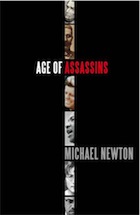
This, broadly, is the theme of a new book Age of Assassins by Michael Newton. This presents itself as a history of assassination between the assassination of Lincoln by John Wilkes Booth (1865) and the attempted assassination of Ronald Reagan by John Hinckley in 1981. (It is pleasing to see that Newton gives space to the relation between the  development of the defence of insanity and assassination though mainly in Victorian England). He argues that the nineteenth century killers were typically ordinary people driven by a (misplaced) desire to make the world better. By contrast as the book moves into the 1960s the assassins of the Kennedy brothers, of Martin Luther King, and of Malcolm X were typically loners, with few clear political motivations and often driven by a desire for celebrity. The argument of the book then paints a slightly odd picture of the decline of the American assassination.

The argument clearly works best as a history of political assassination in the USA. He shows that Lincoln declined protection because assassination was seen as un-American, a form of political violence that was alien to the inclusive new republic. And this can be contrasted with the killings that symbolised the 1960s where assassination has become politically meaningless, an act which which seeks to give meaning to an individual life. But the book is broader than this, covering European anarchism  in the 1850s, the Phoenix Park killings by Irish nationalists in Dublin in 1882, the attempted assassination of Hitler in 1944 and many more. While these are fascinating, it is not always clear how they fit into the story. Occasionally, it is true that the European context is essential to understanding American developments, as with the Russian anarchists who moved to the US and were involved in the attempted murder of the industrialist Henry Frick and the assassination of President McKinley, but in other places their inclusion seems more random and actually might seem to contradict the main argument. As Newton himself admits, political assassination is still resorted to routinely in other parts of the world - think of the political violence in Germany, Italy and the UK in the 1970s or the killing of Olaf Palme for instance - which suggests that a history of political assassination in Europe would look very different. And, of course, there is also the question of state sponsored assassination - notably of Osama bin Laden by the USA - which if included might put a very different spin on the argument.

There are also some interesting criminal law questions raised by the argument. One of the key thoughts that emerges here is the difference between terrorism and assassination. While assassination was often carried out by means of bombs (especially in the nineteenth century) and bystanders could be killed, the aim was not that of terrifying the public or creating a mood of political uncertainty by an extreme act of violence. This suggests that not all political violence is terrorism, and conversely, that it might be appropriate to recognize assassination as a distinct form of murder (as terrorism is a distinct form of violence because of its motivation). This would be because is uniquely serious or because the motivation attending the crime should be recognized in the crime definition. This might seem like an odd suggestion, but it seems clear that not all murders are the same and that the degree or seriousness of the act might be recognized in the definition.

Wednesday, 11 December 2013

On Mary Reid or Timney

I wrote a short post on this case earlier in the year: Mary Timney was the last woman to be publicly executed in Scotland, in Dumfries in 1862. I have now had the benefit of reading the book on the case by Jayne Baldwin that I mentioned in that post.

The story is beautifully told and presents a great deal of new information drawn from newspapers and the court and other official records. There are a number of images of letters, of some of the participants and maps and so on. Only a small part of the book is given over the murder and the trial, which is perhaps unsurprising as the case was fairly clear. The bulk of the book is the story of the efforts to get the sentence commuted and the preparations for the execution itself, and this is grippingly told even if we know the outcome in advance. There is also fascinating discussion of the involvement of local MP William Ewart in the campaign on Mary's behalf and against public executions - which came to fruition in 1868.

This is valuable contribution to our understanding of crime and capital punishment in mid-nineteenth century Scotland. I hesitate to say that it would make an excellent Christmas present - it would, but perhaps only for those with an appetite for the grim for the story it tells is not happy one.


Tuesday, 12 November 2013

On the misinterpretation of the Sexual Offences (S) Act 2009: HM Adv v Mutebi

Much has been made of the the reform of the law of sexual offences in Scotland. The passing of the Sexual Offences (S) Act 2009 was a historic moment, replacing the common law of sexual offences with a new statutory code. The law was being modernised, replacing outdated and gendered conceptions of rape with a new law that placed the protection of sexual autonomy at its core. And this new focus was to be reflected in a new approach to the concept of consent which aimed at altering the balance of the trial.

If the old law was often criticised for allowing the complainer to be put on trial over whether or not she had consented, the new law sought to address this in two ways. First, it aimed to take the question of consent out of consideration in certain cases (the statutory indicators in s.13): if it was proved that a complainer was incapable because of drugs or alcohol, or that violence had been used and so on, then there could be no consent as a matter of law. Second, if the accused claimed that they had a reasonable belief that the complainer was consenting, then it was necessary for the accused to show whether
whether they took any steps to ascertain whether there was consent ...; and if so, to what those steps were. (s.16)
The point of this was that it was for the accused to show what steps they took, rather than for a complainer to have to show that she did not consent.

Of course the law was not perfect. The drafting of many sections is clumsy, but it seemed that the central purpose was clear enough. The law was duly passed in 2009, not coming into force until nearly a year later, so as to allow police, prosecutors and judiciary to be trained in the implementation of the new law. However, with the publication of the judgement of one of the first cases to reach the Appeal Court there are now grounds for suspecting that the judiciary have failed to grasp the structure of the new law and that this may actually undercut its aims.

The case is HM Adv v Mutebi. I wrote about this rather speculatively at the time of the decision, on the basis of press reports, bu now we can see more clearly how it was argued. The case concerned an appeal against conviction by Mutebi who claimed that woman he had sex with had consented (although she was very drunk) and that when she had regained consciousness during the sexual intercourse and had withdrawn consent, that he had in fact withdrawn and left her flat.

There is already something strange about this in that in a situation where the complainer was clearly so drunk that she could not remember whether she had consented or not to sex with a stranger, who then stole her phone and money when he left her flat, was not treated as falling within the scope of s.13 (the jury apparently having decided that she might have consented and deleting the relevant part of the indictment). The case thus seems to proceed on the basis that it was likely that she would have consented to have sex with a stranger who she met on the street while very drunk, rather than regarding this as something out of the ordinary or improbable.

However, if we leave this aside I am interested here in how the Appeal Court approached the question of the application of the provisions of the 2009 Act. What is bizarre about this is that after setting out the relevant provisions of the Act, the Court then proceeded to argue as though the pre-existing common law was still in force. Thus rather than focusing on the question of her physical state and the steps that Mutebi might have taken to ascertain whether or not she was consenting, the Court discussed the evidence of knowledge or recklessness as mens rea of rape, and whether there was evidence to corroborate this.

It should not need stating, but this is clearly not the new law. The 'mens rea' of the offence is that the accused should penetrate the complainer with his penis "without any reasonable belief that B (the complainer) consents". And the definition of how reasonable belief should be approached is now set out in s.16 (above). This does not remove the need for corroboration, which the court discusses at length, but it should be clear that it reframes the way his should be approached.

It is worrying that the Court should have erred on such a simple matter as the interpretation of the new law; but as I suggested above, this is an even greater concern when it threatens to undermine the whole basis of the new law.

Monday, 4 November 2013

On witnesses and veils

The question of whether or not women wearing veils should be permitted to testify has been rumbling on for some time in Britain. Yesterday we were treated to the views of Ken Clarke, Minister without Portfolio in the Coalition government, and former Justice Secretary and criminal barrister. According to Clarke, a proper trial is impossible if a witness is wearing "a kind of bag". He went on
I think the judge and jury have got to see the face of the witness [to] judge their demeanour and decide for themselves whether they are going to rely on this evidence ... It may be you have to make some special arrangements, it may be they'll have to be some screening from the general public, but I actually think it undermines a trial.
Ken Clarke, in costume
Leaving aside his cultural insensitivity (a kind of bag?), it is worth pausing for a moment on the claim which underlies these views. It is the following: that judges and juries can, if they can see a witnesses face, tell whether or not they are lying. If this is correct, then it would appear that there is some scientific basis for this position, and that the law, backed by science, would be justified in asserting its authority over religious and cultural practices which hindered or obstructed the discovery of truth.

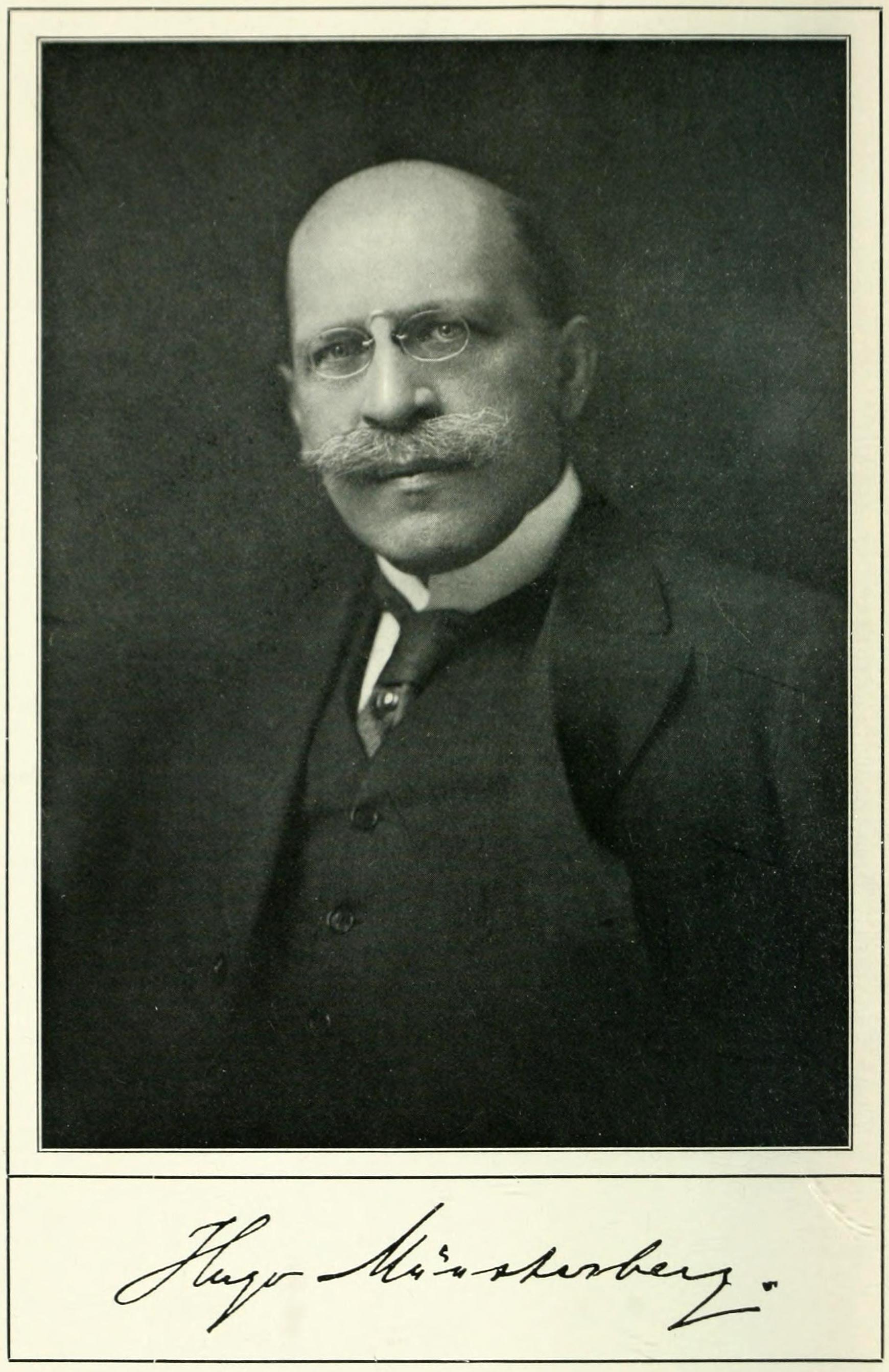
Unfortunately there is little psychological evidence to support these claims. Indeed, studies which have been carried out in this area suggest that professionals (police, immigration officers) are no better at detecting lies than the ordinary person, and that the ordinary person does no better than 50:50. (The suggestion is that poker players may be the best at detecting lies...). There is, of course, a huge amount of folk belief in this area, a lot which can be traced back to ancient superstitions about guilt or unreliability revealing itself through signs: sweating, failure to make contact, nervous tics and so on. These are entertainingly discussed in a famous work by Hugo Munsterberg, one of the pioneers of criminal psychology, called On the Witness Stand (1908). But while claiming the existence of these 'tells', even Munsterberg acknowledged that further psychological research was needed in order to learn properly how to detect them.

In the continuing absence of convincing findings, the claims of lawyers (and politicians) as to the lie detecting powers of judges and juries are no more than folk beliefs. Video or audio evidence is just as likely to produce the same outcomes, and from a scientific perspective there may even be no good reason why we should not rely on written evidence. And whether witnesses given evidence from behind screens or veils, or from a different room should not really have much impact on the ability of the jury to detect whether they are lying or telling the truth.

So what is really going on here. A more plausible way of understanding what is at stake is in terms of confrontation. This is the belief that the trial is at base about bringing the main protagonists together and that the truth will emerge from a series of confrontations: between the accused and their accusers, the lawyer and the witness, between lawyer for the prosecution and defence. This is bolstered by the mythology of the adversarial trial: stories of brilliant barristers breaking down witnesses, of accused persons cracking under sustained cross examination, of the coup de theatre that undermines a key witness. This is the British way of justice, but the audience is less the jury than a broader public who are to be convinced of the reliability of our institutions of justice and those who work in them.

And this is the point: what is really at stake is a clash between the sense of the trial as an event and something which might undermine this. The witness in a veil is seen as undermining this without good reason (though of course there are many excellent reasons for respecting cultural difference). It really has nothing to do with truth, and it would be better for all if this were recognised from the start.

Friday, 25 October 2013

On pumas and Scots criminal law

In March 1976 the landlord of a bar in Leith, Edinburgh was charged in the following terms:
[that he did] keep and allow to go at large, without being under any appropriate care, restraint or control, a puma belonging to (him) or under (his) charge, or in (his) possession, while members of the public were in said public house, and said puma attacked and injured (X and Y) and did recklessly disregard the lives and safety of the public.

The puma in question was apparently normally kept in a cage in the lounge bar (not the public bar). It had apparently at some point been released from its cage by the landlord and had attacked two persons who, according the report, "had previously been asked to leave the premises". The Sheriff convicted the accused of the charge, apparently on the grounds that a puma might be distinguished from domesticated animals kept as pets because it had the
"instincts and unpredictable impulses of a wild animal, rather than a domestic dog, in which ferocity may be a manifestation of its propensity to protect its master's person, property or territory"
Moreover, the fact that the accused had released the puma was evidence of a recklessness towards the safety of others (!).

It would be nice to report that the cases led to the refinement of some legal principle, but unfortunately that is not the case. The landlord appealed against the conviction but, for reasons which have not been recorded, the appeal was dismissed.

An Italian restaurant on the site
of the original Fairley's
For some reason I have not heard of this case before, but it surely deserves to be better known. The decision was not reported, though there a short report in the Journal of Criminal Law (1977 41 J Crim Law 57 for those how have access to the journal). Presumably there was some coverage in the local papers at the time (it is hard to imagine they would ignore it) though I have not had time to check. There is, however, some further information here, which paints an interesting picture of Leith in the 1970s - and raises the possibility that the puma was not the wildest occupant of Fairley's at the time.


Wednesday, 16 October 2013

On Bentham on pederasty (or offences against one's self)

One of the delights of the internet is that it is a treasure trove of obscure or little known documents, access to which would previously only have been open to those with very good libraries - or the time and resources to travel to those libraries. So it was that while I was that, while I was looking for information on Jeremy Bentham's theory of codification, I discovered this fascinating document: Bentham's essay on pederasty, or offences against one's self.

Jeremy Bentham
I have written on Bentham before - about his general theory of criminal law and punishment - but this shorter essay culled from amongst his voluminous unpublished writings is something else altogether. The general approach is in line with his attitude towards the common law and his project of reclassifying the criminal law, but the text, and its history, are revealing in other ways.

In this essay, which was written around 1785 but never published in his lifetime, Bentham examines the justifications given for the criminalisation of so-called "unnatural offences", principally the sexual offences of sodomy, bestiality and masturbation, and the severe punishments which attached to these crimes. He argues that there is little or no evidence that they harm either individuals or society and that there is no possible justification for harsh punishments imposed by the law.

He systematically works through the reasons that have been offered in support of these crimes by a series of distingushed writers, from William Blackstone, to Montesquieu to Voltaire, and dismisses them in turn as riddled with inconsistencies and prejudices and having no possible rational basis.

Thus, there is no evidence that the conduct produces pain; rather it produces pleasure. It cannot be an offence against security or the peace (Blackstone), if it is practised with consent. It cannot hurt the population (Voltaire), or rob women of their rights (!) or be harmful to marriage. And indeed, he asks, if homosexual sex is regularly practised on what basis can it be termed unnatural? The justification for such offences, he concludes seems to lie in a hatred of pleasure, rather than in any possible harm caused by the conduct itself, a position which has been set up by the "prejudices of false philosophy and the terrors of a false religion". In place of this, he argues that on the principle of utility  he argues that there is no justification for these offences (although he does recommend "domestic discipline" as a remedy for for the pernicious and enervating effects of masturbation).

This, then, is a fascinating document, both ahead of its time and strangely of its time. It is ahead of its time as the first known argument for reform of the law of homosexual offences in England, and it demonstrates as characteristic clarity of purpose and rhetorical flourish in its critique of existing criminal laws. It is also strikingly contemporary in its classification of such offences as "offences against one's self" - and thus not to be criminalised in the absence of either harm to oneself or others (or social harm). In this it prefigures the better known work of his pupil, John Stuart Mill, who set out what has come to be known in modern thought as the harm principle: that criminalisation without harm was unjustifiable. And it is also modern in its critique of criminal laws based on moral beliefs or prejudices, and in its aim of replacing prejudice with laws based on reason.

But at the same time it appears very much of its time. This is nowhere more apparent than in the title.  Pederasty for Bentham was the term for consenting homosexual intercourse between men (the term homosexual was not coined until the work of Kraft-Ebbing in the late nineteenth century, and pederasty did not acquire its specifically contemporary meaning of sex between a man and a boy until later). Consistently with this, his examples of the permissibility (and non-harmfulness) of homosexual sex were drawn principally from classical sources. But most notable of all is the tone of the essay, which would sit uncomfortably with modern arguments for law reform. Bentham makes little effort to hide his distaste, repeatedly referring to the perverted tastes of those who engage in such conduct. Indeed, the tone of the essay as a whole struggles to reconcile his arguments about a rational approach to the law with his personal beliefs about homosexual conduct.

And this brings us to the question of why it was not published. It was apparently originally conceived as part of the schema of classification contained in his book On the Principles and Morals of Legislation, one of his few major works that was published in his lifetime. In this book Bentham
proposes a new scheme for the classification of criminal laws that would be consistent with his utilitarian principles (see ch.16). In place of the categories of the common law he proposed a more rational schema based around the interests to be protected by the law, moving from offences against individuals (person, reputation) to objects associated with persons (such as property), to various kinds of public offences (including offences against the positive increase of the national felicity...). And he sought to examine existing laws to see how they would fall within his new classification - either being reclassified or abandoned altogether.

It is easy to see how the essay fits in this schema. But at the last moment it appears that he blanched at publication of this section. According to the editor of this published version, his notes reveal that hee feared that this was a step too far, that it would be damaging to his reputation to be associated with these beliefs, to appear to support homosexual conduct. And so the essay was quietly shelved

So it appears that Bentham the iconoclast, the attacker of irrational beliefs and sacred cows, was not without his limits after all. But if this disappoints, we should be grateful that this work is now freely available, for it offers fascinating insight into both the his beliefs and the mores of his time.


Wednesday, 9 October 2013

On the Appin Murder (1752)

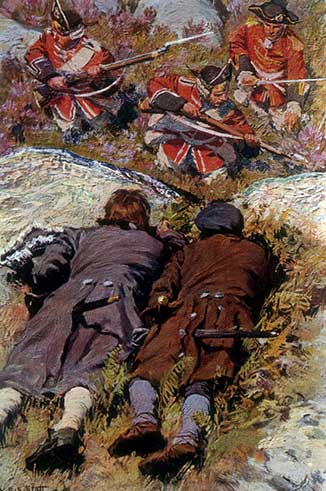
I have been struggling to know what to make of this story - the apparent attempt to re-try James Stewart, convicted and hanged for the murder of Colin Campbell in 1752 (better known as the Appin Murder). A team of modern day forensic experts re-examined the evidence, relating to ballistics etc, before a retired senior judge, and a jury of the public were asked to determine guilt.

Not surprisingly, for it is widely accepted that he was made a scapegoat for the killing, they concluded that James Stewart must have been innocent, and that Alan Breck Stewart (the main suspect, who James Stewart
was charged with abetting) could not be held responsible in the absence of evidence as to his whereabouts at the time. Indeed they conclude therefore that if there was no clear evidence that Breck Stewart committed the crime, then James Stewart could not have abetted its commission, and that there was no basis for an indictment against him.

But this is hardly news. The trial is a notorious miscarriage of justice: a politically motivated trial aimed at suppressing dissent in the turbulent period following the 1745 rebellion. James was scapegoated, a convenient target for the authorities because he was known to have quarreled with the victim and was, moreover, a leading member of the rebellious local Stewarts. The trial was held in Campbell country - Inverary - before an unsympathetic judge and jury. Legal argument was limited and legal niceties such as doctrines of complicity were brushed aside in the rush to obtain a conviction. Moreover, there was nothing that we would understand as forensic evidence, and the kind of legal protections that we take for granted today were considerably less robust. So it is hardly surprising that, judged by modern standards of forensic evidence and criminal procedure, the outcome is found wanting. So why do it


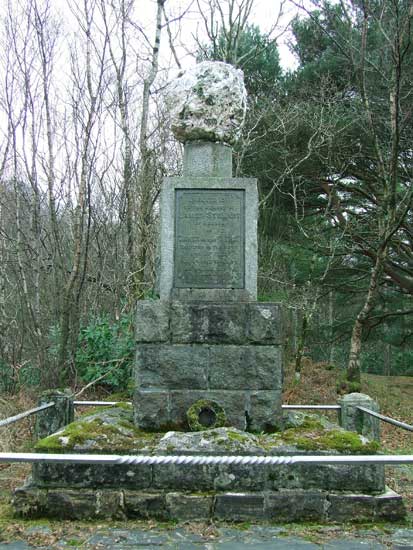
James Stewart's Monument,
Ballachulish
Perhaps the only novel finding is that the two shots which were fired came from two different muskets, rather than a single one, as had usually been assumed - a finding which resonates in a strange way with contemporary conspiracy theories about multiple shooters of President Kennedy in Dallas. But this does not help to identify the shooter, or tell us if Breck Stewart fired one of the shot. It is, though, consistent with the idea that there was a planned element to the attack, as the two shots must have been fired more or less simultaneously as witnesses reported hearing a single shot and it was long assumed that the two musket balls found in the victim had been shot at the same time from the same gun. This underlines the theory that the attack was motivated by political discontent - as we knew anyway - though this still does not support any assumption that James Stewart was involved.

Robert Louis Stevenson

The case clearly fascinates - though it is likely that few would have heard of it today were it not for the brilliant novels of Robert Louis Stevenson (Kidnapped and Catriona) which took the case as their backdrop.
Even in these works Stevenson is careful to hedge his bets - while he seems to suggest that Breck Stewart is responsible, he does not go so far as to depict him actually pulling the trigger, and in other respects paints him as a romantic rebel with whom the reader sympathises. And as befits someone who is known to have read the legal account of the trial (and was trained as a lawyer) he does not pretend that the trial was fair - and even without the benefit of contemporary forensic evidence he is able to lay bare the injustice of the outcome.

So faced with these alternatives it is surely better by far just go and read the novels - for which we surely need no excuse.