Yesterday saw a momentous event in Scotland - the conviction of Ronnie Coulter for the murder of Surjit Singh Chhokar in 1998. Coulter was originally tried (and acquitted) for the murder in 1999, but was put on trial again this year following the change in the double jeopardy laws in 2011. The four week trial ended yesterday when the jury returned a verdict of guilty for the murder after deliberating for 10 hours.
The story of the case, at least in its early stages, was one of institutional racism and botched decision making. It was fairly clear from the start that three man had been involved in the incident that led to the killing of Chhokar - Ronnie Coulter, his nephew Andrew Coulter and David Montgomery. The Crown then had two separate trials, each of which collapsed when the men on trial blamed the others for the killing. This was heavily criticised by Lord McCluskey at the original trial of Ronnie Coulter. As a result the three men went free.
This was followed by three separate investigations into the failings in the case. The first was an internal investigation by Elish Angiolini (later to be Lord Advocate) into the handling of the case by the fiscal service. The second one, as the profile of the case was rising, was by Sir Anthony Campbell QC into the investigation and prosecution of the offence. And the third, and most damning, was a report by Raj Jandoo into institutional racism in the handling of the case. The Jandoo report found that there was evidence of institutional racism in the failure of the police to consider that the offence might have been racially aggravated, in the failure of the Crown Office to explain its decision making to the family, and in the courts to explain why it was that the trials had collapsed. These issues were to be addressed by the police and fiscal service, but nothing could be done at the time to bring the men to trial again. This changed with the reform of the double jeopardy laws in 2011, which allowed a person who had been acquitted of a crime to be tried again for the same offence, under certain limited circumstances.
The investigation remained open and this year the new prosecution was brought against Ronnie Coulter - with each of the other two men testifying against him. He in turn led a defence of incrimination - that the other men had committed the crime - and that they were blaming him because of a series of family feuds and to avoid their own liability.
The history of the case tracks the developments in Scottish criminal justice over the last 18 years - a period that coincides with the development of devolved Scottish government. One important change, I have already noted, was the reform of the double jeopardy laws, but more important were two larger movements that suggest how Scottish criminal justice was modernising. The first was the increased recognition of human rights, and in this particular context, of the rights of the victim. There have been extensive developments in the law to protect victims as witnesses, to improve the service offered to victims in court, and to render the process of prosecution decision making more open and accountable to victims. The second development is the recognition of hate crime - including forms of racially aggravated crime. These map on to the serious deficiencies identified by the Taylor and Jandoo reports and their have been significant advances in these areas.
This is not to say that there are not still deficiencies - note the recent problems of Police Scotland - or that racist crimes may not still take place. But we can at least hope that victims and their families will receive better and fairer treatment from criminal justice institutions.
Finally, I would like to pay tribute to the family of Surjit Singh Chhokar, and to Aamer Anwar, their solicitor, whosetireless activism has done much to ensure that the case was kept in the public eye, that public bodies were made to account for their actions, and that ultimately the killer of Surjit Singh Chhokar was convicted.
This is a blog about the history, theory and practice of the criminal law. I shall write about books, cases, trials, novels that catch my interest, and even occasionally about current events. My aim is not comment on current caselaw or issues in criminal justice, but to rather to develop a more oblique critique of the law.
Oblique intent
Why the name? Well criminal law afficionados will recognise the phrase 'oblique intent' as referring to a problem of mens rea:can a person who intends to do x (such as setting fire to a building to scare the occupants) also be said to have an intention to kill if one of the occupants dies? This is a problem that has consumed an inordinate amount of time in the appeal courts and in the legal journals, and can be taken to represent a certain kind of approach to legal theory. My approach is intended to be more oblique to this mainstream approach, and thus to raise different kinds of questions and issues. Hence the name.
Thursday, 6 October 2016
Monday, 7 September 2015
On Making the Modern Criminal Law
The blog has been dormant for a long time, and this is because I have been working on a larger project - finishing a long book about the development of the modern criminal law. I am very pleased to say that the manuscript is now complete and with the publishers, and this means that I will now resume posting on a regular basis.First a word about the book. It is called Making the Modern Criminal Law. Criminalization and Civil Order, and it will be be published by Oxford University Press in January 2016. (There are more details on the OUP website, and you can even pre-order the book). I will be writing more about the book over the coming months as well as covering the usual mixture of topical and historical stories.
Sunday, 15 June 2014
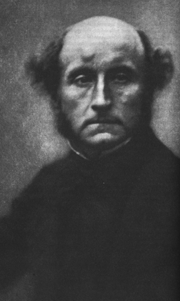
On JS Mill and the harm principle
But what did Mill understand by this term? A
useful starting point for understanding this is Mill’s essay on civilization,
published in the London and Westminster Review in 1836. Mill
understood the term ‘civilization’ to have a broad and a narrow sense. The broad
sense was the way in which we might speak of a society as more perfect, as
“happier, nobler, wiser”, as in the civilization of ancient Greece or Rome. The narrow sense was comparative: the term could be used to distinguish a
wealthy and populous nation from savages and barbarians, but in doing so could
also recognize that the progression of civilization might be accompanied by new
miseries or give rise to new kinds of vices.
Focusing on this latter sense Mill argued that the degree of civilization could
be measured by the degree of co-operation in a society: “Wherever, therefore,
we find human beings acting together for common purposes in large bodies, and
enjoying the pleasures of social intercourse, we term them civilized”. Savage society was violent and power could be exercised in an arbitrary way. In
a civilized society security, which he understood as the protection of individual
interests, would depend on the collective arrangement of society, rather than
on individual strength or courage. Indeed for Mill this was the measure of
civilization, as he want on to argue that “There is not a more accurate test of the
progress of civilization than the progress of the power of co-operation”. Co-operation in his view was something that was learned in the progress of
civilization – the division of labour was, in his phrase, the “great school of
co-operation”. Civilization brought about the diffusion of property and
intelligence throughout society and taught self-control and compromise, the
sacrifice of individual will to a superior purpose.
Why does this matter? Its importance, I think, lies in the sense in which Mill was establishing preconditions. The harm principle does not apply to all, but only to those individuals and those societies which qualify. It must be understood in this sense not as a simple statement about the limits of state power, but in terms of a more complex relation. The operation of the ‘harm principle’ was linked to the division of labour
and the degree of social progress, both in the sense of whether or not it was
appropriate to a particular society or group within that society, and in the
sense that civilization could give rise to new vices or harms. And of course the important questions then becomes those of who is to judge whether you meet the entry criteria for the club of civilization and according to which criteria is this judgment made.
I have two further comments about this. First, it is clear that this judgment was made on the basis of cultural assumptions about the the superiority (and civilized character) of western societies. So for Mill this justified, in particular the British Empire in the Indian subcontinent and Africa as a civilizing project. Imperial rule could be despotic because the barbarians could not govern themselves
Second, once you are aware the way this distinction, you will be surprised at how often it is still used even in the present day as a means of justifying non-liberal measures. Rioting is uncivilized behaviour and the police are the the thin blue line which stands between us and the breakdown of civilization - so liberal principle s of law may be suspended. Once you look you will see many examples of this kind, which makes you think about the continuing importance of the idea of civilization.
Tuesday, 1 April 2014
On proportionality, harm and order
Patrick Colquhoun (1745-1820) is famous as a penal reformer and one of the founders of the modern police. He began his career as a merchant in Glasgow before moving to London in 1785, becoming a magistrate in the East End of the city - an area that covered the docks. It was his work here that prompted him to write his most famous work, A Treatise of the Police of the Metropolis, which was first published in 1796. In this book he argued for a new system of police and criminal law to address the problem of theft from the docks and the welfare of the community more generally. His proposals were adopted and a new river police force established in 1800, that was to become one of the models for the creation of the metropolitan police in 1829.
The following is quote from his book:
“It is the triumph of liberty when the criminal laws proportion punishment to the particular nature of the offence … In offences which are considered by the legislature as merely personal and not of the class of public wrongs, the disproportion is extremely shocking. If, for instance, a personal assault is committed of the most cruel, aggravated, and violent nature, the offender is seldom punished in any other manner than by a fine and imprisonment, but if the delinquent steals from his neighbour secretly more than the value of twelve pence, the law dooms him to death” (Colquhoun, Treatise on the Police of the Metropolis 6th edn. 1800 pp.30 & 35)
This is interesting as
comment on eighteenth century criminal law. Most obviously it is a critique of
disproportion in punishment and an argument for reform. The eighteenth century
law is criticised for brutality (that a thief is punished by capital
punishment) and for disproportion (that an aggravated assault is scarcely
punished at all, and certainly not capitally). This fits with the well known
picture of eighteenth century criminal law as
brutal and arbitrary.
Second, it is
implicit in any claim about disproportion that there is some other truer
measure of proportion or the proper relation between things. Here, for
Colquhoun, the proper measure is public wrong in the sense of harm to the community.
The idea of harm in this sense can become for Colquhoun a measure of commensurability
between different types of wrongful conduct, allowing them to be ranked in terms
of seriousness.
Finally, this is linked into the bigger claim, taken from Montesquieu,
that there is a link between proportion and liberty. The proper order of the criminal
law will secure a broader order. The reform of the criminal law is thus linked to
the refoundation of society.
Sunday, 30 March 2014
On overcriminalisation
We often like to think that the police are always keen for new criminal legislation, because it will give them a greater range of 'tools' from which to choose when doing their job. And we also often think that the tendency to over-produce criminal legislation is a recent one. In this connection then it is interesting to read the comments of C. F. G. Masterman, Liberal politician, chronicler of the state of England, and Parliamentary Under-Secretary at the Home Office from 1909 to 1912.
He recalled that Home Office principles relating to restrictive legislation were
(1) ‘Do not, unless forced to do so, make crimes out of things which are not crimes already’;
(2) ‘Do not introduce proscriptive legislation beyond the standard of conduct which will be accepted by the general feeling of the country’;
(3) ‘Do not throw upon the police a burden greater than they can bear’
(from S Petrow, Policing Morals, Oxford 1994, p.42)
He recalled that Home Office principles relating to restrictive legislation were
(1) ‘Do not, unless forced to do so, make crimes out of things which are not crimes already’;
(2) ‘Do not introduce proscriptive legislation beyond the standard of conduct which will be accepted by the general feeling of the country’;
(3) ‘Do not throw upon the police a burden greater than they can bear’
(from S Petrow, Policing Morals, Oxford 1994, p.42)
Tuesday, 4 March 2014
On the Oscar Pistorius trial
I expect that we will be hearing a lot about the Oscar Pistorius trial over the coming weeks, but I doubt I will read anything better than this, by Margie Orford - a perfect explanation of how doctrines like self defence require a context in which they make sense.
Friday, 28 February 2014
On sexual offences
The criminal law has always
regulated sexual conduct in some way. However, it has not always been the same
kinds of conduct that have been regulated, or regulated in the same way, in
every society, for the same ends. Even the most cursory historical
survey suggests that there has been considerable diversity in the kinds and
manner of regulation of sexual conduct by the criminal law. This raises questions when we come to think about how sexual offences should be regulated by the criminal law. The tendency in modern thought is to see this as a distinct area of law, to look for an organizing principle or interest that should be protected, and then to try and systematically apply this to the identification and definition of possible offences.
One immediately striking feature of the law in the area of sexual offences is that the idea of a distinct body of sexual offences is relatively novel. By this I mean that the idea of sexual offences as a distinct sub-field of the criminal law, organised around a the protection of a distinct interest or wrong or according to a central governing principle, is a fairly recent development in the criminal law. The term sexual offences was not used in any legislation in the UK until 1956, and not in the US until the Model Penal Code in 1962, and, while occasionally used as a descriptive term in treatises before this date, it was little more than a usage of convenience, a way of describing a sub-category of offences against the person. It was not until the 1970s that the idea of sexual offences began to change from being a descriptive grouping to something that reflected an underlying organizing principle - that of the protection of sexual autonomy.
This led to some notable instances of decriminalization of consensual sexual conduct seen as inconsistent with the idea of sexual autonomy - notably the decriminalisation of homosexual conduct - and this is usually seen as the major development in this area. However, arguably the larger impact has been in terms of increased criminalization, as the recognition of this distinct interest in sexual autonomy has led to the identification of a growing range of ways that this can be infringed or interfered with. Recent legislation on sexual offences in the UK has thus criminalized voyeurism, sexual grooming of children, 'sexting', sexual interference with a corpse, possession of extreme pornography, sex with trafficked women and many more. The point here is less that of whether or not these should be crimes (many of them already were, but were not seen as sexual crimes), than to ask the question of how it is that they come to be classified as sexual offences - and more broadly to ask whether the recognition of the category might not have an expansionary logic.
This suggests that before we can take the idea of a category of sexual offences for granted and think about how it is best organised or regulated, it is necessary first to ask about how it is that certain behaviors been grouped together under the rubric of sexual offences, about the kinds of connection or thematic unity that makes this grouping possible, and about the consequences for criminalization of thinking in categories of this kind.
Subscribe to:
Posts (Atom)